
The Quantum Ledger · updated daily
How much bitcoin sits behind a public key that is already public?
Bitcoin is protected by keys a future quantum computer might one day break, but only where the public key can be seen. This page measures that part, every day since 2009, and explains why published estimates disagree.
What this number is not. No quantum computer can use these keys today, and nobody knows when or whether one will. Exposed coins are not lost or at risk of theft today; their owners can still move them. The number measures where a future attack could start, nothing more.
Data to November 17, 2026 (UTC) · updated 2026-11-18 04:27 UTC · source Bitview, checked on every run
Four numbers from the ledger
- 7.17M BTC, 35.7% of all bitcoin, sat behind a public key already visible on the blockchain on November 17, 2026.
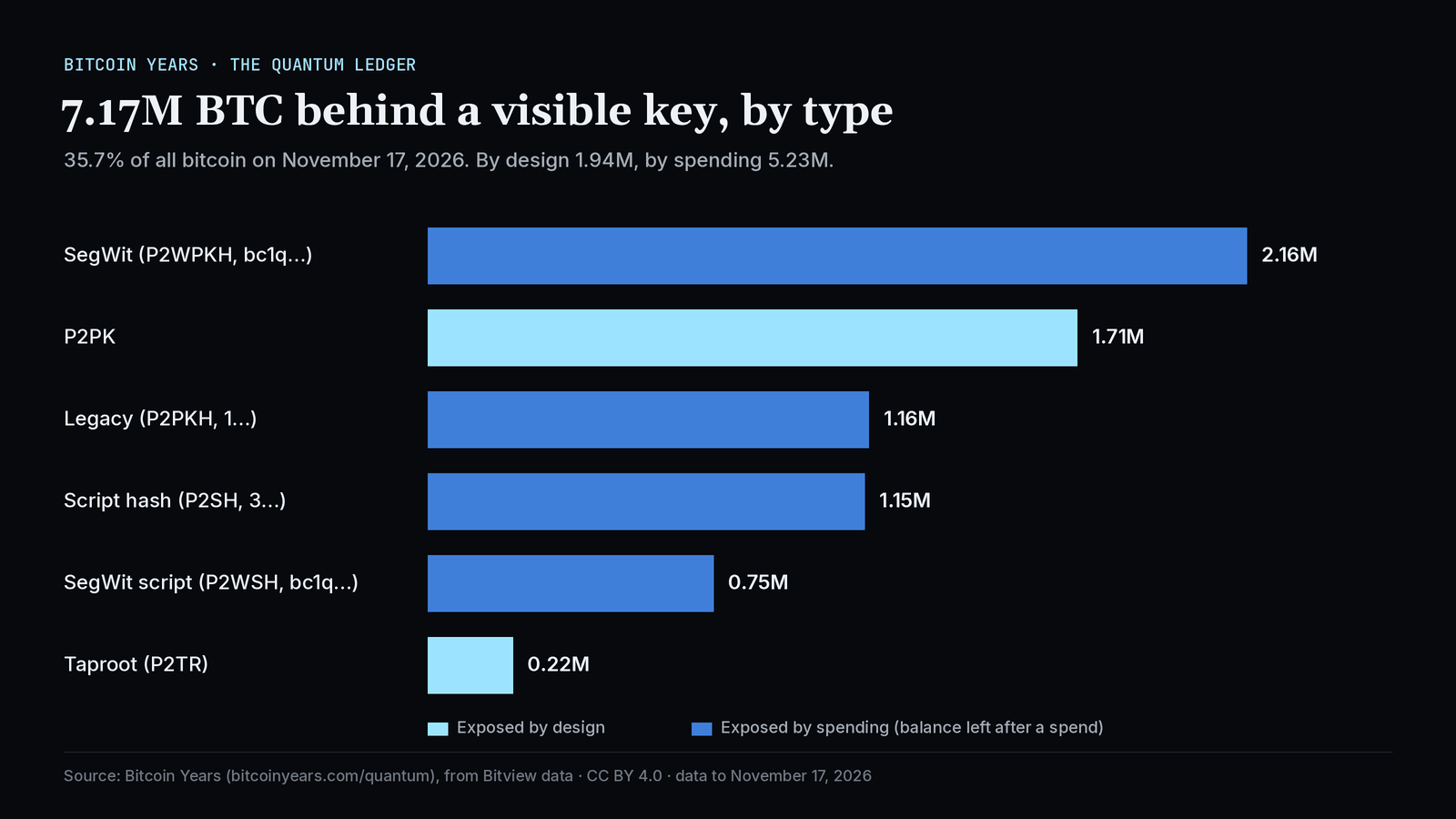
- 1.94M BTC is exposed by design, in P2PK and Taproot outputs; the other 5.23M BTC is exposed because its address has already spent.
- 1.71M BTC sits in 38,072 P2PK keys, mostly block rewards from Bitcoin’s first years; 21,922 unspent rewards (1,096,100 BTC) come from blocks that match the Patoshi mining pattern.
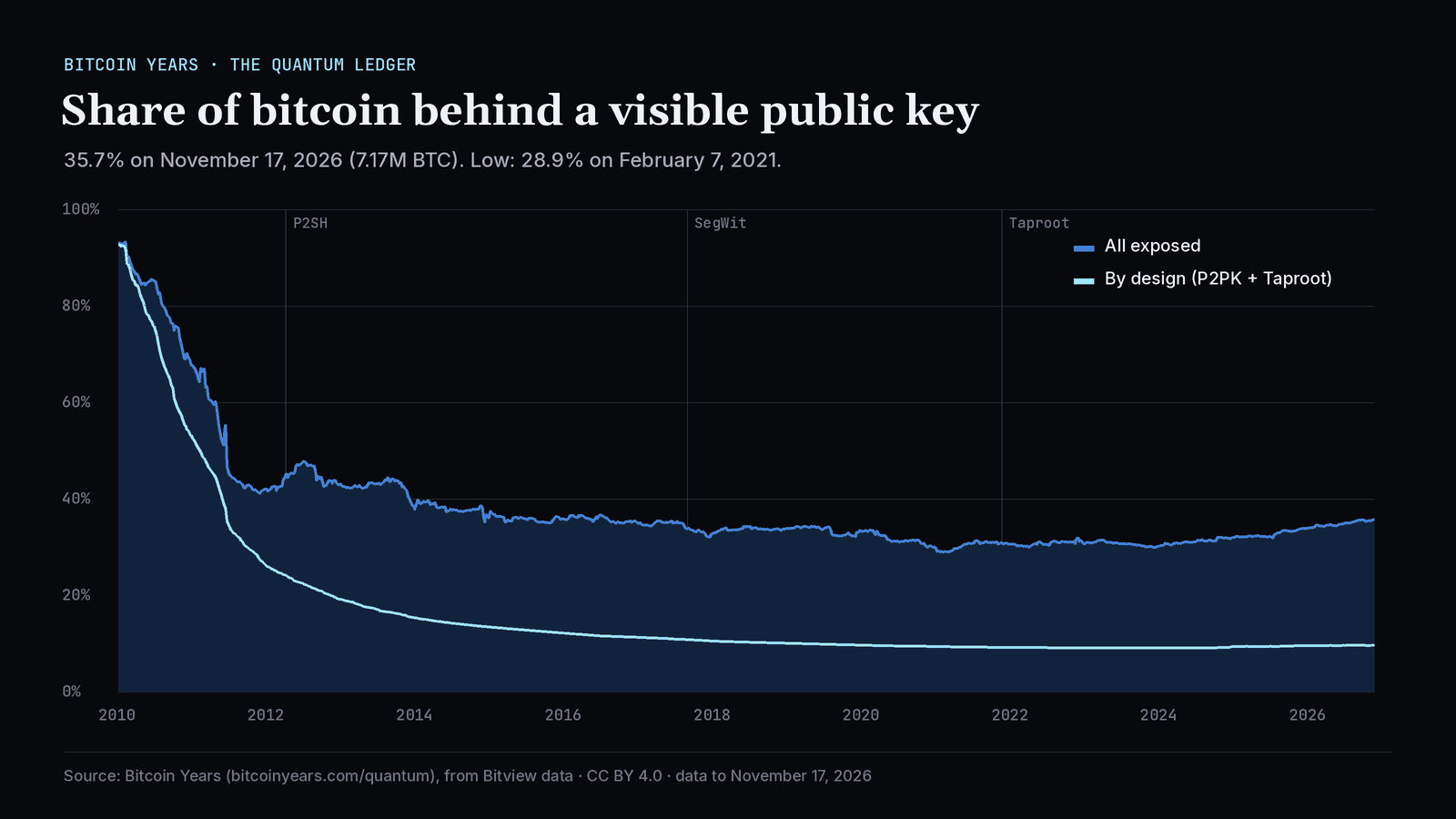
- The exposed share fell to a low of 28.9% in 2021 and has risen since: 33.8% a year ago, 35.7% now.
No quantum computer can use these keys today. Figures are recomputed every day from the source; quote them with their date. How to cite: below.
7.17M BTC is exposed: 1.94M by design, 5.23M by spending
A public key is exposed once it appears on the blockchain. Two different things put it there, and they are worth keeping apart.
Structural · 1.94M
P2PK and Taproot outputs carry the public key in the output itself. They are exposed the moment they are created, whatever the owner does.
Operational · 5.23M
The other address types hide the key behind a hash until the first spend. A balance left on an address after it has spent sits behind a revealed key.
Not exposed · 12.94M
Addresses that have never spent, of a hash-based type. Their key is not on-chain yet; it will be when they spend.
| Script type | Exposed BTC | % of supply | 12 months |
|---|---|---|---|
| P2PK | 1,714,469 | 8.52% | −3,901 |
| Taproot (P2TR) | 224,656 | 1.12% | +42,467 |
| Legacy (P2PKH, 1…) | 1,164,959 | 5.79% | −64,959 |
| Script hash (P2SH, 3…) | 1,153,110 | 5.73% | −107,570 |
| SegWit (P2WPKH, bc1q…) | 2,161,825 | 10.75% | +555,363 |
| SegWit script (P2WSH, bc1q…) | 754,432 | 3.75% | +14,864 |
| All exposed | 7,173,451 | 35.7% | +436,264 |
Balances are unspent bitcoin held on November 17, 2026. The six types do not overlap and add up to the total (checked daily). Bare multisig outputs (P2MS, 68 BTC) also show their keys but are not in the source series. The 50 BTC genesis output, which can never be spent, is left out.
Terms this page keeps apart
- Exposed public key
- A key that appears on the blockchain: in a P2PK or Taproot output, or in the input that spent from an address. 14,069,112 funded addresses have one today.
- Unspent output
- Bitcoin not yet spent. Every amount on this page is unspent bitcoin; spent coins are no longer anyone’s exposure.
- Previously spent output
- The spend that revealed the key. It is the cause of operational exposure, not a holding, so it is never counted as exposed bitcoin.
- Reused address
- An address that received more than once. Reuse alone does not reveal a key; only a spend does. Reused-address balances are therefore not used as an exposure measure here.
- Structural exposure
- Exposure that comes from the output type itself (P2PK, Taproot).
- Operational exposure
- Exposure that comes from how coins were handled: a balance left behind after a spend.
From ten thousand to seven million: the estimates count different things
Each step below adds one kind of exposure to the one before. Every published figure sits on one of these steps; read it with its definition and the gap closes.
Published estimates beside our same-day figure
| Source and date | Published figure | Ours, same day |
|---|---|---|
| CoinShares · report Feb 2026 | 1.63M BTC in P2PK outputs; 10,230 BTC of it in addresses holding 100 BTC or more | Our P2PK figure: 1.72M |
| Project Eleven (Bitcoin Risq List) · report Apr 2026 | 6,934,064 BTC | Our total: 6.91M |
| Glassnode Research May 2026 | 6.04M BTC (30.2%): 1.92M structural + 4.12M operational | Our total: 6.91M |
| Rafael Schultze-Kraft (Glassnode co-founder) · report Oct 2026 | 6.26M BTC (31.2%) | Our total: 7.10M–7.15M |
Two address-level methods agree: Project Eleven’s 6.93M BTC and our 6.91M BTC on the same day differ by 0.4%. Glassnode’s structural figure (1.92M) matches ours (1.92M); its operational figure follows the key rather than the address and is lower. Figures we could not trace to a dated, primary publication are not listed.
Exposure fell for a decade; since 2021 it has been rising again
At the start of 2010 about 93% of all bitcoin sat in exposed outputs, nearly all of it P2PK. Hash-based addresses took over, and the exposed share fell to its low of 28.9% on February 7, 2021. It stood at 35.7% on November 17, 2026, against 33.8% a year earlier. Over the last twelve months the largest increase came from SegWit (P2WPKH, bc1q…): +555,363 BTC.
Weekly points from the daily series. Vertical lines mark when P2SH (2012), SegWit (2017) and Taproot (2021) became valid on Bitcoin. Sudden steps are usually single large holders spending or consolidating; the data shows the move, not who made it.
1.71M BTC in 38,072 P2PK keys, barely moving
P2PK outputs were the default for block rewards in Bitcoin’s first years. Their keys have been visible ever since. The balance peaked at 2.68M BTC (March 2011) and has hardly changed for a decade: P2PK coins leave only a little at a time.
Net change of P2PK balances per calendar year; 2026 is the year to date. Over the last five full years, P2PK holdings fell by 29,206 BTC in total.
Satoshi-era coins: three levels of certainty
FactBlock rewards from 2009 and 2010 were paid to P2PK outputs; their keys are on the blockchain. Of 21,953 block rewards checked weekly, 21,922 are still unspent (1,096,100 BTC).
PatternThose blocks were selected by the Patoshi pattern, Sergio Demian Lerner’s analysis of nonce and timestamp traces that groups them as the work of one early miner. On that basis they make up about 64% of today’s P2PK balance.
HypothesisThat this miner was Satoshi Nakamoto is widely believed and not provable from the chain. This page treats it as a hypothesis. More in Sleeping giants.
Last Patoshi check: 2026-11-11.
What this page cannot measure
How long exposed coins have been sitting still. Our source publishes exposure by script type, and coin age for all bitcoin, but never the two together; combining them would mean guessing. So this page does not say how much exposed bitcoin is dormant or lost. For coin age across all bitcoin, see Holder data.
How much block space would moving today’s exposed coins take?
Moving coins to a new address type uses today’s signatures, so this is a block-space question, not a cryptography one. Change any assumption and the result updates. It is a scenario, not a forecast.
Input sizes (virtual bytes), editable
| P2PK | – | signature only (the key is in the output) |
| Taproot (P2TR) | – | Taproot key-path signature |
| Legacy (P2PKH, 1…) | – | signature + compressed key |
| Script hash (P2SH, 3…) | – | from P2SH-wrapped SegWit (91) to a 2-of-3 legacy multisig (297) |
| SegWit (P2WPKH, bc1q…) | – | SegWit v0 signature + key |
| SegWit script (P2WSH, bc1q…) | – | 2-of-3 SegWit multisig (105) to larger scripts (140) |
| New output | 43 vB each, one per transaction; 10.5 vB per transaction | |
Typical sizes from the Bitcoin Optech size calculator; real spends vary with the wallet.
Assumes one input per exposed address (14,069,112 today), which is a lower bound: an address holding several outputs needs several inputs. It covers only coins that are already exposed; moving all bitcoin would take far more. Blocks are counted at 1,000,000 virtual bytes, about 144 a day.
After a migration: post-quantum signatures are larger
Spending from a post-quantum output would need a post-quantum signature and key. Their sizes (in bytes) are set by the standards; the chart shows how many simple one-in, one-out spends would fit in a block with each.
| Scheme | Signature | Public key | Status |
|---|---|---|---|
| Schnorr (BIP 340, today) | 64 | 32 | In use since 2021 |
| FN-DSA-512 | 666 | 897 | Draft standard |
| ML-DSA-44 | 2,420 | 1,312 | Final standard |
| ML-DSA-65 | 3,309 | 1,952 | Final standard |
| SLH-DSA-SHA2-128s | 7,856 | 32 | Final standard |
Assumption: signature and public key go in the witness (one weight unit per byte; for today’s Taproot the key is already in the output), plus 40 bytes of script and control data and a 94-byte non-witness part per spend, in a block of 4 million weight units. No signature scheme has been chosen for Bitcoin; this compares sizes, not proposals.
Two drafts in the BIPs repository, none active
These are the quantum-related proposals with a number in the official BIPs repository. Their status is read from the repository on every update. This page describes them in their authors’ terms and takes no position on them.
Pay-to-Merkle-Root (P2MR)
Status: Draft SpecificationAdds a new output type, Pay-to-Merkle-Root (P2MR): Taproot-style script trees without the key-path spend, so the output does not show a public key while it waits to be spent. It defines the output type, not a post-quantum signature scheme.
Authors: Hunter Beast, Ethan Heilman, Isabel Foxen Duke
Post Quantum Migration and Legacy Signature Sunset
Status: Draft InformationalDescribes a migration after a post-quantum output type exists: first stop sending to quantum-vulnerable addresses, later stop accepting legacy ECDSA and Schnorr signatures. Coins not moved in time would then need a separate recovery path. It is informational and depends on a post-quantum signature BIP that does not exist yet.
Authors: Jameson Lopp, Christian Papathanasiou, Ian Smith, Joe Ross, Steve Vaile, Pierre-Luc Dallaire-Demers
A BIP number means a proposal is documented, not that it is accepted. Activating a soft fork needs software releases and broad adoption; see Bitcoin forks for how past changes went.
Is an address type exposed by design?
Paste a Bitcoin address. The check runs only in this browser: the address is not sent, stored or logged anywhere (this page is not allowed to make outside connections). It tells you the address type and what that means. It cannot tell you whether the address has ever spent, because that needs a blockchain lookup.
The genesis block pays to a public key, not to an address
A private key is a secret number. The public key is derived from it and can be shown safely today, because going back from public to private key is infeasible for ordinary computers. Shor’s algorithm on a large quantum computer would change that, which is why it matters whether the public key is visible.
This is the public key in the genesis block’s only output, exactly as it sits on the blockchain:
Most addresses are a hash of a key instead. Press the button to hash this key in your browser (SHA-256, then RIPEMD-160) and encode it as an address.
The address that explorers show for the genesis output is derived this way; the output itself contains the full key. Learn the steps in the Cryptography Lab.
Cite the ledger, use the charts
Everything on this page is free to reuse under CC BY 4.0. Credit “Bitcoin Years, from Bitview data” with a link to this page, and give the date of the figure you quote.
1600 × 900, credit line drawn in, redrawn with every daily update. Prefer a live chart on your site? Use the free quantum widget.
Suggested citation
Bitcoin Years. (2026). The Quantum Ledger: Bitcoin quantum-exposed supply by script type [Data set, daily; data to 2026-11-17]. Based on Bitview data, CC BY 4.0. https://bitcoinyears.com/quantum/ · Archived: https://doi.org/10.5281/zenodo.24287390
@misc{bitcoinyears_quantum_ledger,
  author       = {{Bitcoin Years}},
  title        = {The Quantum Ledger: Bitcoin quantum-exposed supply by script type},
  year         = {2026},
  howpublished = {\url{https://bitcoinyears.com/quantum/}},
  doi          = {10.5281/zenodo.24287390},
  note         = {Daily data set based on Bitview data, CC BY 4.0. Data to 2026-11-17}
}A dated snapshot of the data set is archived on Zenodo with a permanent DOI: 10.5281/zenodo.24287390. Cite the DOI for a fixed version, this page for the latest figures.
Media contact
Questions about the data or the method: [email protected]. We can provide a figure for a specific date or address type from the published series.
How the numbers are made
DataDaily series from Bitview (CC BY 4.0): exposed balance and funded exposed addresses for P2PK, P2TR, P2PKH, P2SH, P2WPKH and P2WSH, and the circulating supply, from January 9, 2009. Bitview counts an address as exposed when its public key or spending script has appeared on-chain: P2PK and P2TR when funded, the other types once they have spent.
ChecksOn every update the whole history is downloaded again and must pass: the six types add up to the total; no type exceeds its own supply; Taproot exposure equals Taproot supply; P2PK exposure differs from P2PK supply only by the 50 BTC genesis output; address counts add up; no day is missing; supply never falls; no day in the last month moves by more than 3%; the history matches our previous copy. If anything fails, nothing is replaced and the last good data stays online.
Our choicesShares are exposed balance divided by circulating supply. The genesis output is removed. Values are rounded to whole bitcoin. Address types the source does not cover (bare multisig, about 68 BTC) are named but not added.
LimitsExposure is address-based: a key revealed by one address is not linked to other addresses of the same wallet. Coins held by custodians are counted by their addresses, not by owner. Nothing here measures how close a quantum computer is.
Common questions
How much bitcoin is vulnerable to quantum computers?
No bitcoin can be taken by a quantum computer today. What can be measured is exposure: on November 17, 2026, 7.17M BTC (35.7% of all bitcoin) sat in addresses whose public key or spending script is already on the blockchain. That is the part a sufficiently large future quantum computer could attack without waiting for its owner to move it.
Why do estimates range from 10,000 to 7 million BTC?
They measure different things. Counting only large P2PK holdings gives about ten thousand; all P2PK gives about 1.7 million; adding Taproot gives 1.94M; adding every address that has spent and still holds a balance gives 7.17M. Glassnode's key-level method gives a lower operational figure than address-level methods like ours and Project Eleven's.
Are Satoshi's coins exposed?
The earliest block rewards were paid to P2PK outputs, so their public keys have been visible since 2009. 21,922 unspent block rewards (1,096,100 BTC) come from blocks matching the Patoshi mining pattern, which researchers attribute to a single early miner widely believed to be Satoshi Nakamoto. The pattern is strong evidence, not proof of ownership.
Is my bitcoin exposed?
If you use a fresh address for every payment and have never sent from the address that holds your coins, its public key is not on the blockchain (Taproot addresses are the exception: they show a key as soon as they are funded). Our address check tells you the type of an address without sending it anywhere; whether it has ever spent is something only a blockchain lookup can show.
Can a quantum computer break Bitcoin today?
No. Breaking a Bitcoin key needs a large fault-tolerant quantum computer that does not exist. Published estimates of when one might exist differ widely; this page does not make one.
What is BIP-360?
BIP-360 proposes a new output type, Pay-to-Merkle-Root (P2MR), that does not show a public key while it waits to be spent. It is a draft in the BIPs repository, not active on Bitcoin. Its status on this page is read from the repository daily.
Data and licence
Free to reuse under CC BY 4.0: credit “Bitcoin Years, from Bitview data”. Modified from the source: rounded, genesis output removed, shares and splits derived.
Related research
Sources
- Bitview: exposed-address supply series (daily, CC BY 4.0)
- BIP 360: Pay-to-Merkle-Root (P2MR)
- BIP 361: Post Quantum Migration and Legacy Signature Sunset
- NIST FIPS 204: ML-DSA
- NIST FIPS 205: SLH-DSA
- IETF draft: FN-DSA for JOSE and COSE (FIPS 206 sizes)
- Glassnode Research: Measuring Bitcoin's quantum-exposed supply
- Project Eleven: Bitcoin Risq List
- CoinShares: Quantum vulnerability in Bitcoin, a manageable risk
- Bitcoin Optech: transaction size calculator
- Sergio Demian Lerner: the Patoshi pattern (2019 summary)