
The Lost Bitcoin Ledger · updated daily
How many bitcoins are lost?
Nobody can count lost bitcoin: a coin that has not moved may simply be held. What can be counted is how long coins have been still, and what is provably gone. This page measures both every day and lines up the published estimates.
Still is not lost. The chain shows when coins last moved, not whether anyone holds the keys. Long-held savings, cold storage and lost coins look the same. This page never calls a coin lost; it measures how long coins have been still.
Data to November 17, 2026 (UTC) · updated 2026-11-18 04:26 UTC · source Bitview, checked on every run
Four numbers from the ledger
- 3.60M BTC, 17.9% of all bitcoin, had not moved in ten years or more on November 17, 2026; 2.22M BTC had not moved in fifteen.
- Only 230 BTC is provably gone: destroyed by the protocol’s own rules or sent where no key can spend it.
- 1.10M BTC sits in 21,922 untouched block rewards that match the Patoshi mining pattern of 2009–2010.
- Old coins still wake up: 53,563 BTC older than ten years moved in the last twelve months; the largest day since 2019 was 80,015 BTC on July 4, 2025.
Figures are recomputed every day from the source; quote them with their date. How to cite: below.
From 230 BTC to 3.60M: a ladder of certainty
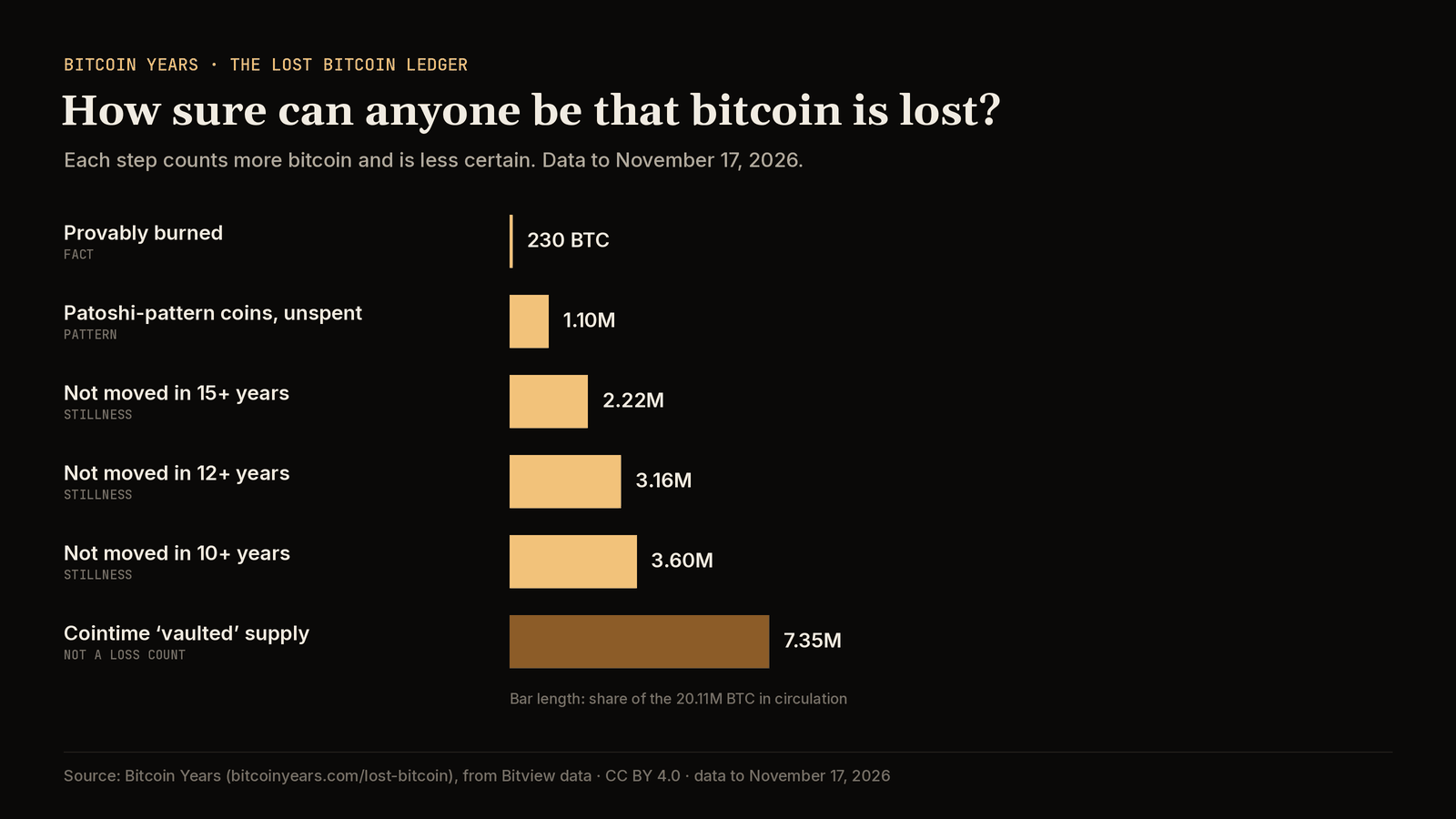
Each step counts more bitcoin and is less certain. Only the first step is a fact about loss; the rest measure stillness.
Bar length: share of the 20.11M BTC in circulation on November 17, 2026. The steps overlap: Patoshi-pattern coins are part of the 15+ year step, which is part of the 12+ step, and so on. Cointime’s ‘vaulted’ supply (Glassnode’s ‘HODLed or lost’) splits supply by how little it has been used; it counts long-term holders too, so it is shown for comparison, not as a loss figure.
Provably burned coins can never be spent by anyone. The number is small and exact.
Patoshi-pattern coins are early block rewards grouped by Sergio Demian Lerner’s nonce analysis as one miner’s. That the miner was Satoshi is widely believed, not proven. More in Sleeping giants.
Coins not moved for years are measured exactly. Whether they are lost is a guess; every published estimate of lost bitcoin is a version of this guess.
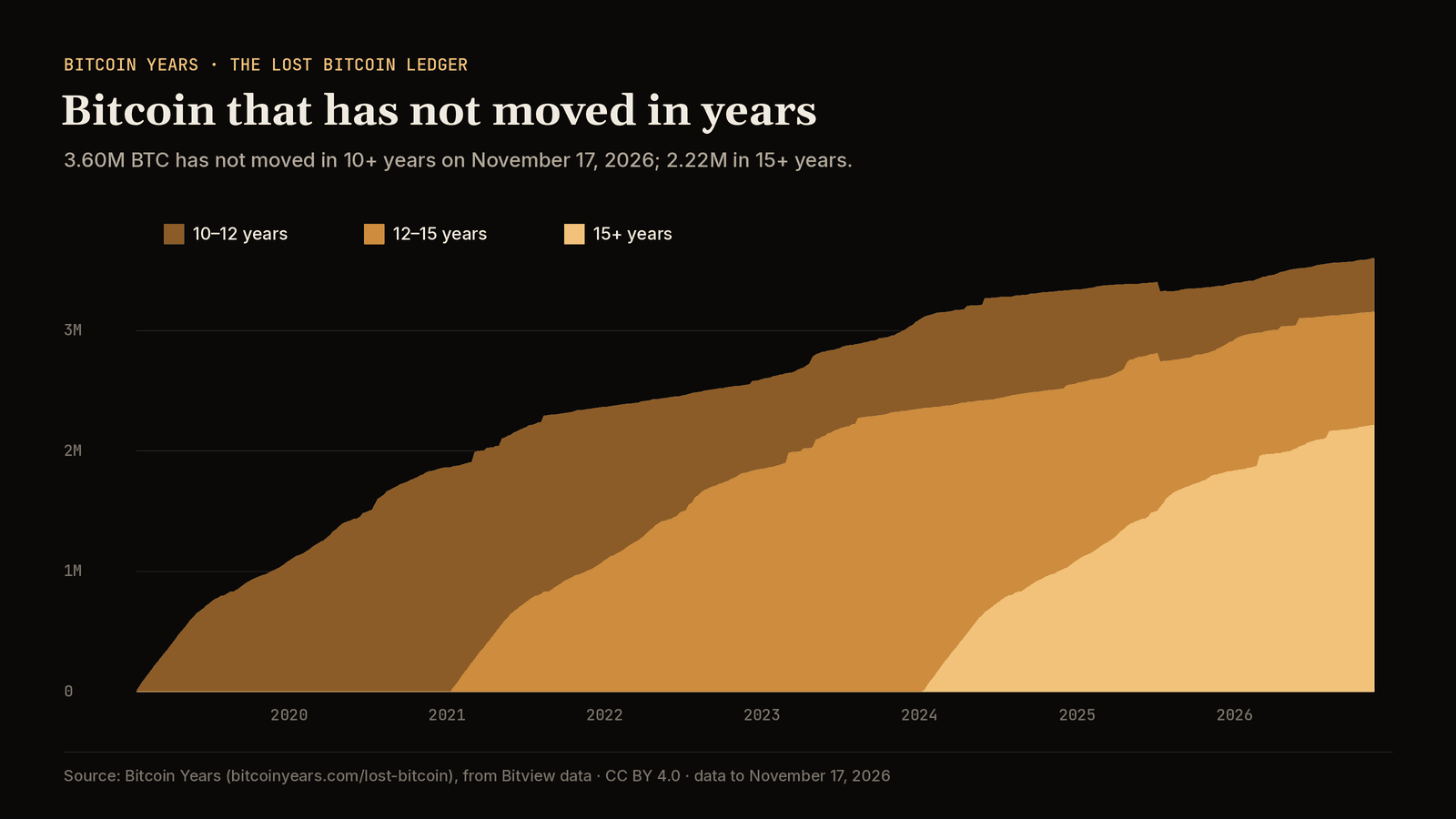
Bitcoin not moved in ten years grew from zero in 2019 to 3.60M
The first coins turned ten in January 2019. Every day since, coins from Bitcoin’s second decade age into the ten-year band, and a few old ones leave it by moving. A year ago the band held 3.37M BTC.
Weekly points from the daily series. Bands are UTXO age: the time since each coin last moved.
53,563 BTC older than ten years moved in the last twelve months
Every move of an old coin is a coin that was not lost. Since the first coins turned ten, 283,581 BTC older than ten years has moved; 3,284 BTC in the last thirty days.
The largest days
| Day (UTC) | Older than ten years, moved |
|---|---|
| July 4, 2025 | 80,015 BTC |
| October 23, 2025 | 4,102 BTC |
| July 24, 2025 | 3,974 BTC |
| November 11, 2022 | 3,742 BTC |
| May 5, 2025 | 3,443 BTC |
| December 3, 2024 | 2,823 BTC |
| March 1, 2024 | 2,395 BTC |
| February 21, 2022 | 2,200 BTC |
A move is counted when coins older than ten years are spent; where they went is not shown. Large days are usually single holders consolidating or moving coins; the data shows the move, not who made it. Individual old addresses are followed in Sleeping giants.
Published estimates beside our same-day measure
Each estimate counts something different. Read with its definition, each one lines up with a measurable layer.
| Source and date | Published figure | Ours, same day |
|---|---|---|
| Chainalysis (via Fortune) November 2017 | 2.78M–3.79M BTC | Not moved since 2011 or earlier: 2.52M |
| Coin Metrics (via CryptoSlate) Block 600,000 (October 2019) | More than 1.6M BTC | Provably burned at that block: 182.7 BTC |
| Chainalysis (via Fortune) Mid-March 2024 | 1,798,681 BTC | Not moved in 10+ years (3.16M) minus Patoshi-pattern coins: ≈2.07M |
Coin Metrics’ provably lost part (about 182 BTC at block 600,000) and our burned total at that block (182.7 BTC) agree. Patoshi-pattern coins are subtracted using today’s count, since they have barely moved. Figures we could not trace to a dated publication with a stated method are not listed.
230.1 BTC no key can ever spend
| Part | BTC |
|---|---|
| Genesis block reward | 50 |
| Duplicate coinbases (2010) | 100 |
| Unclaimed rewards | 28.96 |
| OP_RETURN outputs | 51.19 |
| Provably burned | 230.15 |
Coins sent to vanity ‘burn’ addresses (such as 1BitcoinEater…) are not here: no key for them is known, but one could exist, so they are not provably gone.
Cite the ledger, use the charts
Everything on this page is free to reuse under CC BY 4.0. Credit “Bitcoin Years, from Bitview data” with a link to this page, and give the date of the figure you quote.
1600 × 900, credit line drawn in, redrawn with every daily update.
Suggested citation
Bitcoin Years. (2026). The Lost Bitcoin Ledger: bitcoin by time since last move, and provably burned bitcoin [Data set, daily; data to 2026-11-17]. Based on Bitview data, CC BY 4.0. https://bitcoinyears.com/lost-bitcoin/ · Archived: https://doi.org/10.5281/zenodo.24323891
@misc{bitcoinyears_lost_bitcoin_ledger,
  author       = {{Bitcoin Years}},
  title        = {The Lost Bitcoin Ledger: bitcoin by time since last move, and provably burned bitcoin},
  year         = {2026},
  howpublished = {\url{https://bitcoinyears.com/lost-bitcoin/}},
  doi          = {10.5281/zenodo.24323891},
  note         = {Daily data set based on Bitview data, CC BY 4.0. Data to 2026-11-17}
}A dated snapshot of the data set is archived on Zenodo with a permanent DOI: 10.5281/zenodo.24323891. Cite the DOI for a fixed version, this page for the latest figures.
Media contact
Questions about the data or the method: [email protected]. We can provide a figure for a specific date or age band from the published series.
How the numbers are made
DataDaily series from Bitview (CC BY 4.0): circulating supply by UTXO age band (the time since each coin last moved), bitcoin spent from each age band per day, provably burned value with its parts, and Cointime’s vaulted supply. Patoshi-pattern block rewards are checked weekly against the unspent set (Sleeping giants).
ChecksOn every update: age bands add up to the supply; long- and short-term holder supply add up; cumulative burned series never fall; burned equals genesis plus duplicates plus unclaimed rewards plus OP_RETURN value; the burned total at block 600,000 matches Coin Metrics’ published figure. If anything fails, nothing is replaced and the last good data stays online.
Our choices‘Not moved in N years’ is the sum of the UTXO age bands N years and older. Values are rounded to whole bitcoin. Exchange and custodian coins are counted like any others: an address that holds still is counted, whoever owns it.
LimitsAge is per output, not per owner: a holder who moves one coin resets that coin only. Moving coins between one’s own addresses resets their age even if nothing was sold. Nothing here can tell held coins from lost ones; that is why no single ‘lost’ number is given.
Common questions
How many bitcoins are lost forever?
Nobody can know for sure, because a coin that has not moved may still be held. What can be measured: only 230 BTC is provably destroyed; 3.60M BTC (17.9% of all bitcoin) has not moved in ten years or more on November 17, 2026, and 2.22M BTC in fifteen years or more. Published estimates of lost bitcoin mostly fall inside that range, depending on what they count.
Why do estimates of lost bitcoin differ so much?
They count different things: only provably destroyed coins (a few hundred BTC), coins idle since a cut-off year, or a model of how many old coins are really lost. Some include the coins attributed to Satoshi, some exclude them. Read each figure with its definition and the gap mostly closes.
Are Satoshi's coins lost?
Unknown. 21,922 block rewards (1,096,100 BTC) from blocks matching the Patoshi mining pattern have never moved. The pattern points to one early miner, widely believed to be Satoshi Nakamoto, but that is not provable from the chain, and unmoved is not the same as lost.
What does provably lost mean?
Bitcoin that no key can ever spend: the 50 BTC genesis reward, two coinbase outputs overwritten by duplicate transactions in 2010 (100 BTC), rewards miners never claimed (29.0 BTC) and value sent to OP_RETURN outputs (51.2 BTC). Together 230.1 BTC on November 17, 2026.
Do lost bitcoins ever come back?
Coins presumed lost sometimes move. In the last twelve months 53,563 BTC older than ten years moved; the largest single day since 2019 was 80,015 BTC on July 4, 2025. Each such move is a coin that was not lost after all.
Does lost bitcoin change the 21 million supply?
No. The protocol limit stays 21 million; lost coins still exist on the chain. What changes is how many coins can actually be spent, which nobody can measure exactly.
Data and licence
Free to reuse under CC BY 4.0: credit “Bitcoin Years, from Bitview data”. Modified from the source: rounded, bands summed, weekly sums derived.