History · 2010 to 2026 Every Bitcoin crash, and what came after
Bitcoin has been declared dead hundreds of times. It has lost more than three quarters of its value five times, been robbed, banned and betrayed. These are the 19 crashes that shaped it, from the bug that printed 184 billion coins to the Binance hack of October 2026.
Bitcoin price on the first day of each month since July 2010, log scale. Shaded areas are the crashes below; tap a number to jump to its story. Monthly prices hide the deepest intraday lows, which are given in each story.
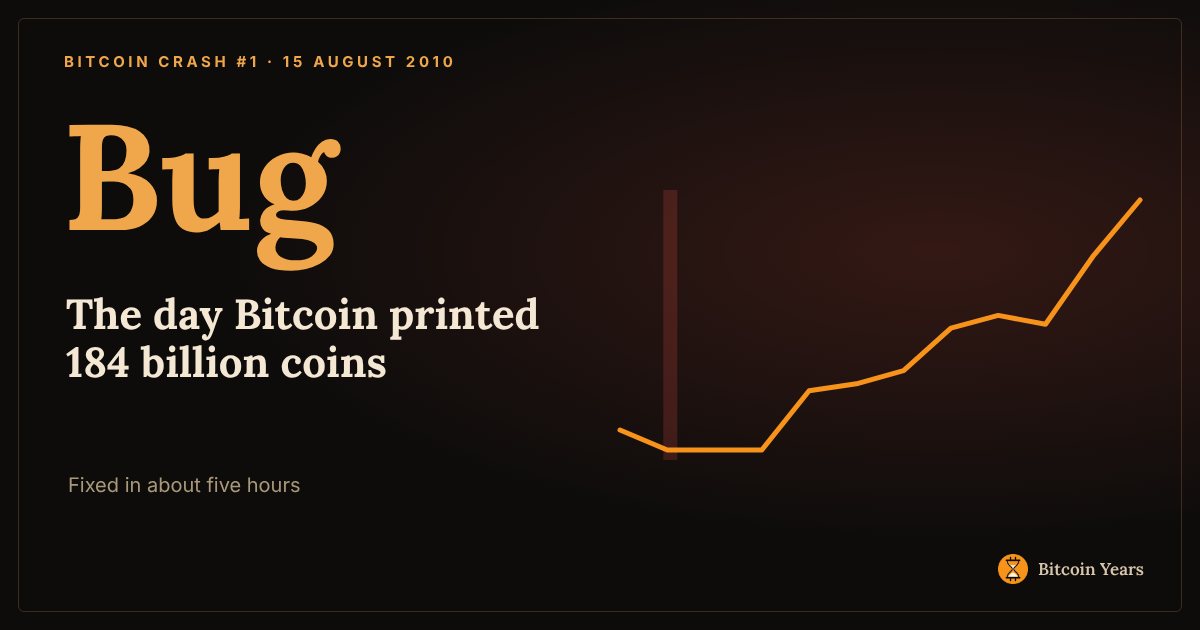
Bitcoin was barely 19 months old and worth a few cents when someone found a hole in its rules. On 15 August 2010, block 74,638 contained a transaction that created more than 184 billion bitcoin out of nothing, split between two addresses. The code that checked transactions had not been written for numbers so large that adding them together overflowed.
For a system whose whole promise was a fixed supply of 21 million coins, it was an existential moment. Satoshi Nakamoto and the handful of early developers published a fixed version of the software within about five hours. Miners who upgraded started building a new chain without the bad block, and on 16 August, at block 74,691, the corrected chain overtook the broken one.
There was hardly a market to crash, but this was Bitcoin's first real crisis, and it set the pattern for every one that followed: the network survived because enough people chose to run the fixed rules.
The lesson: A bug can break the code. Only the network decides which rules survive.
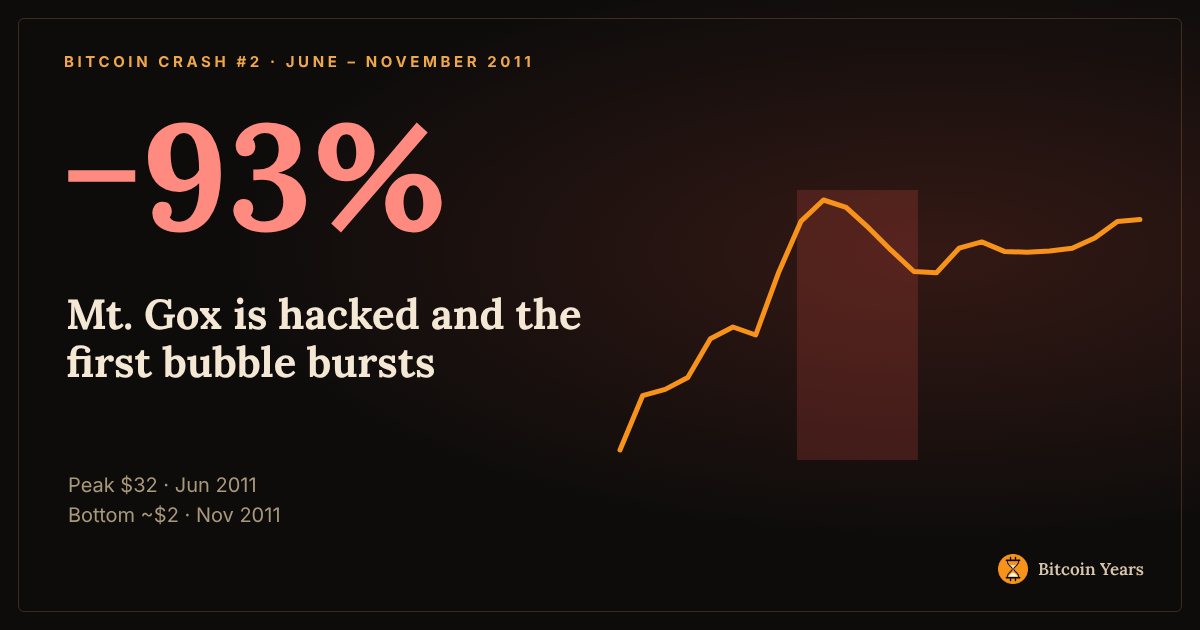
In the spring of 2011 Bitcoin went from obscurity to headlines. A magazine story about an untraceable internet currency sent new buyers flooding in, and on the Mt. Gox exchange the price climbed from under $1 to about $32 in early June.
Then Mt. Gox was breached. An attacker used a compromised account to dump a huge pile of bitcoin onto the exchange, and for a few surreal minutes on 19 June the price on Mt. Gox fell to a single cent. Trading was halted for days and the trades were rolled back, but the spell was broken.
What followed was slower and more painful. Through the summer and autumn the price bled away, falling to around $2 by November, a loss of more than 90%. Many early believers sold, and the press declared the experiment over. It took until early 2013 for the price to climb back above its 2011 high.
The lesson: The first exchange failure was not the last. Bitcoin held on an exchange is only as safe as the exchange.
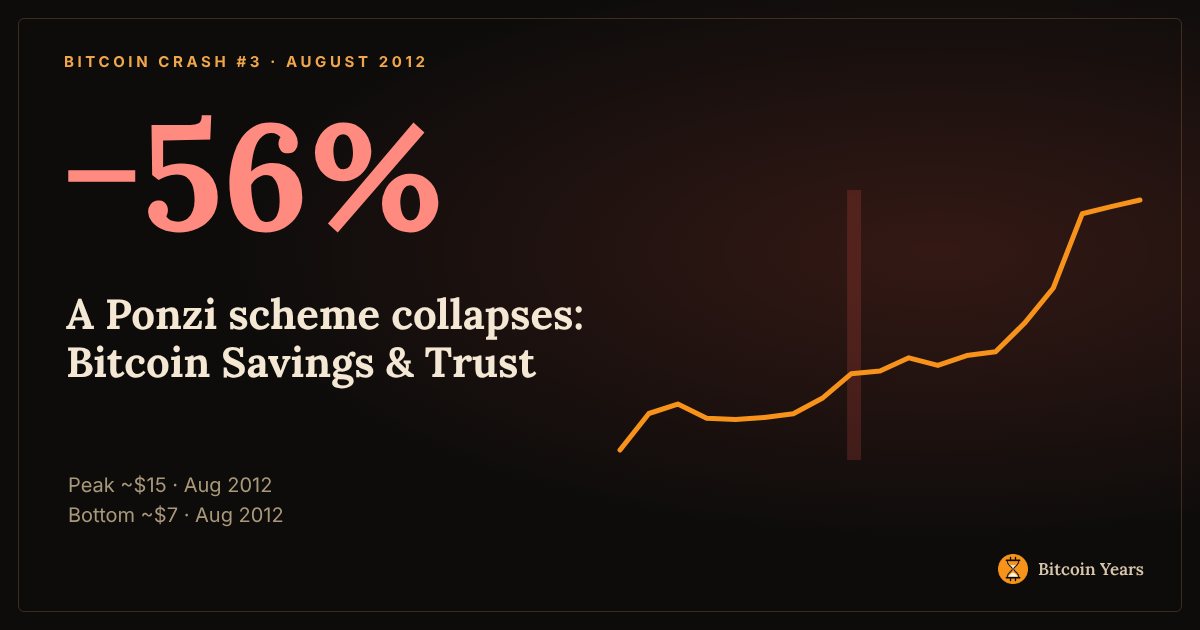
In late 2011 a user known as “pirateat40”, later identified as Trendon Shavers, began offering an investment with an impossible promise: 7% interest per week, paid in bitcoin. He called it Bitcoin Savings & Trust, and in a small, trusting community it grew into the biggest operation in the Bitcoin economy.
In August 2012 it began to unravel. Pirate announced he was closing, and on 28 August he defaulted. Fear of how many coins might be dumped, and how much money had simply vanished, sent the price from about $15 to under $7 in a matter of days.
The US Securities and Exchange Commission later charged Shavers with running a Ponzi scheme, one of the first fraud cases involving Bitcoin. Bitcoin itself recovered within months, but the episode was an early lesson in a pattern that would return again and again: the scams around Bitcoin did more damage than any flaw inside it.
The lesson: If a yield sounds too good to be true, it is someone else’s money.
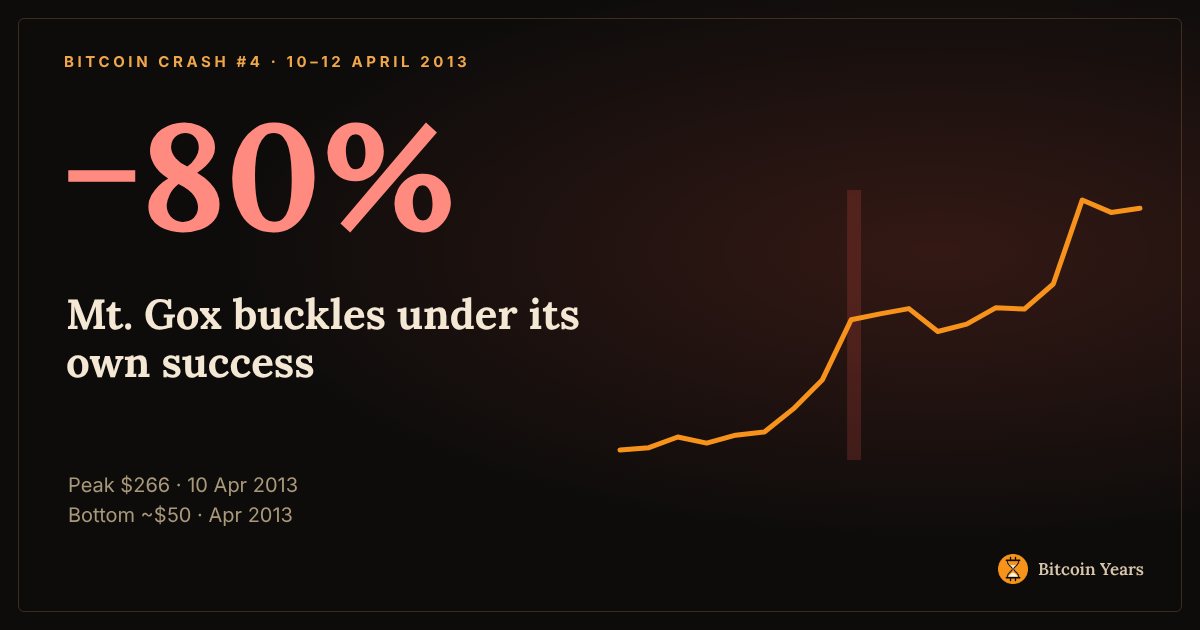
The banking crisis in Cyprus in March 2013, where savers saw part of their deposits seized, gave Bitcoin a new story: money that no government could freeze. The price rocketed from about $13 in January to $266 on Mt. Gox on 10 April.
Mt. Gox, which handled most of the world’s Bitcoin trading, could not keep up. Orders lagged, the site slowed under heavy traffic and attacks, and traders who could not see the real price panicked. Within a day the price had roughly halved, and Mt. Gox halted trading to let the market cool down. At the worst moments that week bitcoin changed hands for around $50.
The crash exposed how fragile the infrastructure still was. Yet by the end of the year Bitcoin was trading above $1,000. The demand that had caused the bubble had not gone away; only the plumbing had failed.
The lesson: In a market that never sleeps, the weakest link is often the exchange, not the asset.
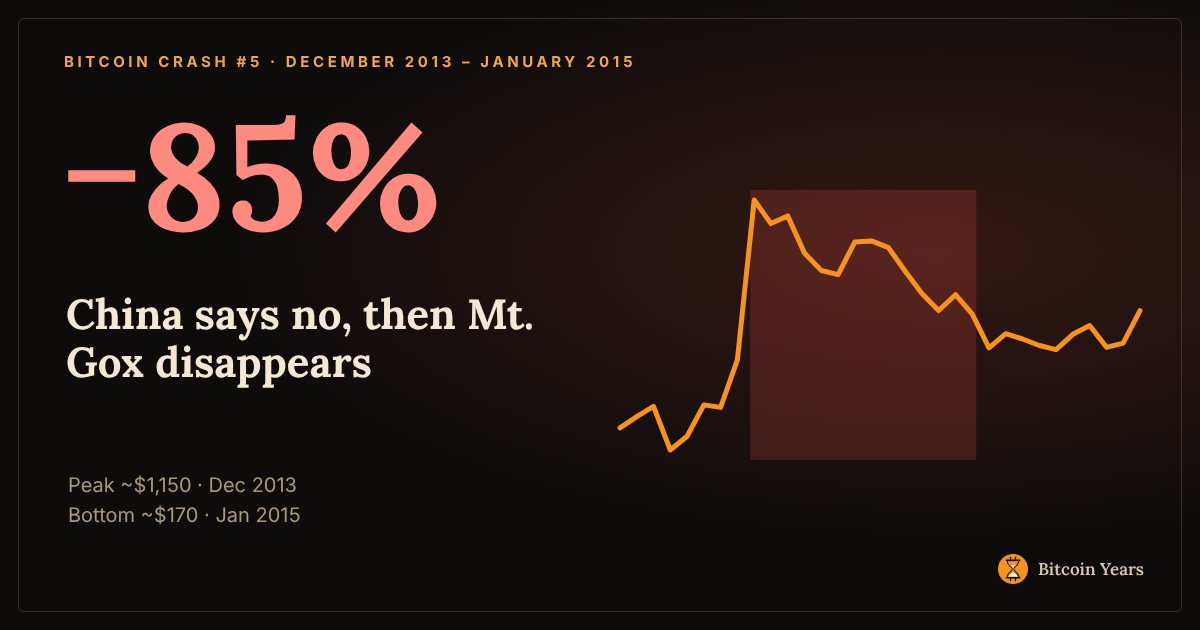
By late November 2013 Bitcoin had passed $1,000, driven by a buying frenzy in China. On 5 December the People’s Bank of China ruled that banks and payment companies could not handle Bitcoin. Within days the price had fallen by about half.
The real blow came from Tokyo. In February 2014 Mt. Gox stopped all withdrawals, and at the end of the month it filed for bankruptcy, saying about 850,000 bitcoin belonging to customers and the company had gone missing over years of hacks and mismanagement. About 200,000 were later found. At the time it was roughly 7% of all bitcoin in existence.
What followed was Bitcoin’s longest winter so far. The price slid through 2014 and touched about $170 in January 2015, more than 85% below the peak. Creditors would wait a decade for repayment. It took until early 2017 for Bitcoin to reclaim its 2013 high, but the industry that rebuilt after Mt. Gox was larger, more professional and more careful.
The lesson: The biggest exchange in the world can still fail. “Not your keys, not your coins” was born here.
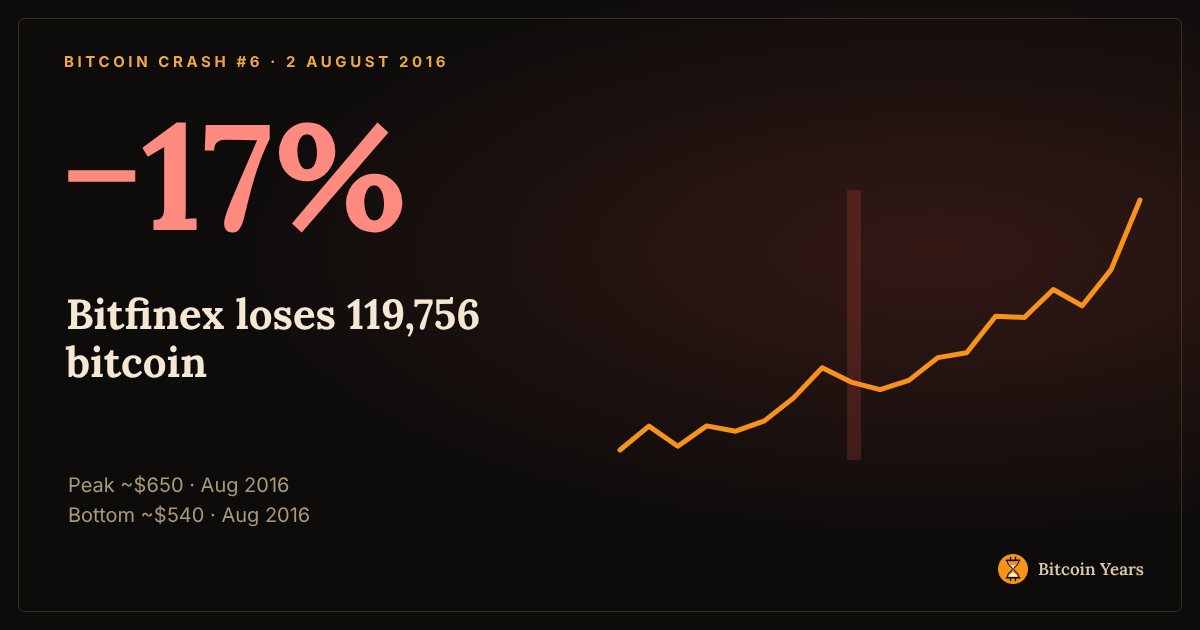
Two years after Mt. Gox, the market was quietly recovering when Hong Kong-based Bitfinex, one of the largest exchanges, announced a security breach. Hackers had stolen 119,756 bitcoin, worth about $70 million at the time.
The price fell from about $650 to around $540, close to 20%, as traders feared another Mt. Gox. Bitfinex did not go bankrupt. Instead it spread the loss across all of its customers, cutting balances by about 36% and handing out tokens it promised to buy back, which it did within a year.
The story had a remarkable ending. In 2022 US authorities seized most of the stolen coins, by then worth billions of dollars, and arrested a New York couple who later pleaded guilty to laundering them. The market had recovered within months; the stolen bitcoin took six years to surface.
The lesson: A hack can be survived. The blockchain never forgets where the coins went.
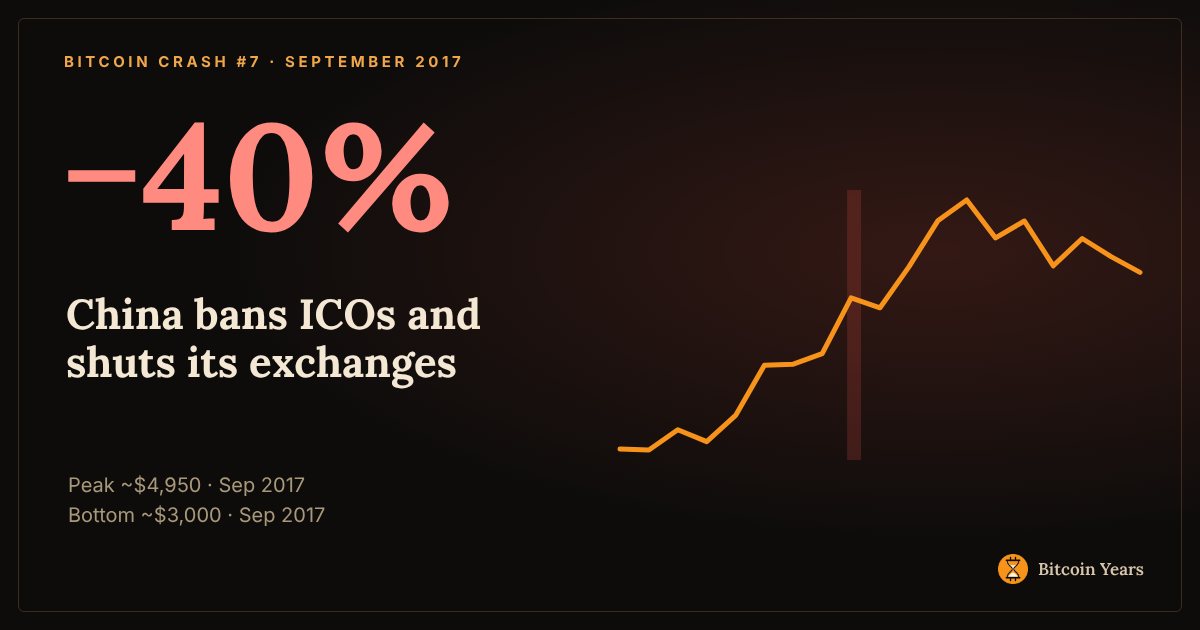
In 2017 the world discovered crypto. Thousands of new tokens were sold to the public through initial coin offerings, and a large share of the trading happened in China. On 4 September Chinese regulators declared ICOs illegal fundraising and ordered them stopped.
Days later, reports spread that Chinese exchanges would be forced to close, and the largest ones confirmed it. Bitcoin, which had just touched about $4,950, fell to around $3,000 by mid-September, a drop of roughly 40% in two weeks.
It barely mattered. Trading moved offshore, and by mid-October Bitcoin was at new records. The crash became a footnote in the year of the great mania, but it showed that even the world’s second-largest economy could not switch Bitcoin off.
The lesson: A government can close an exchange. It cannot close the network.
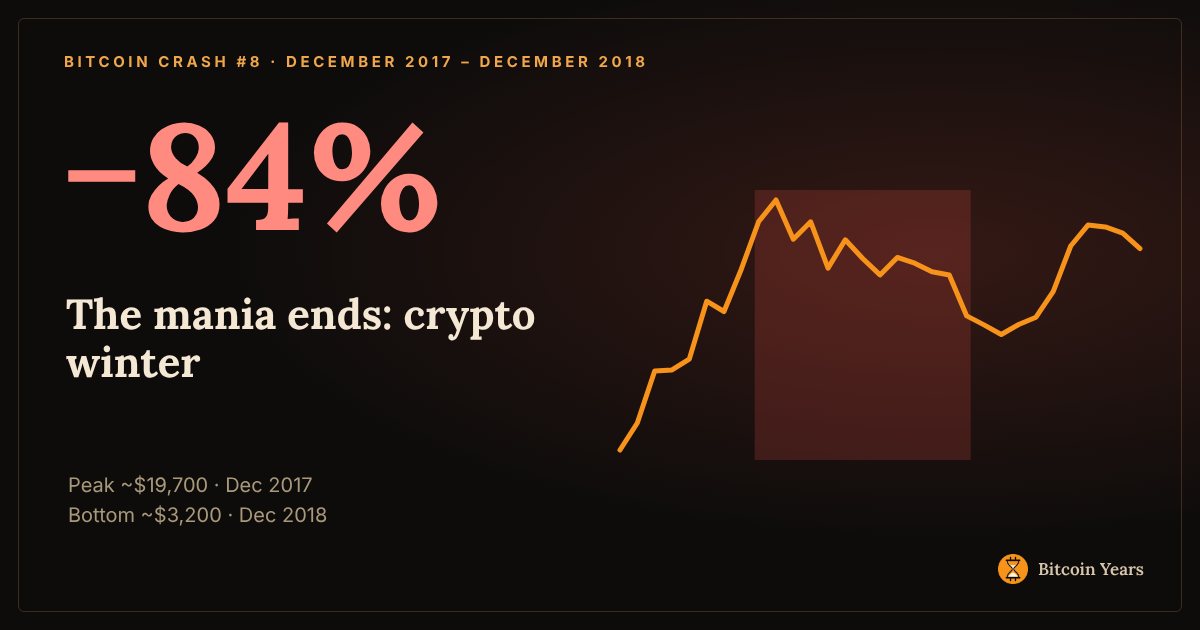
In December 2017 Bitcoin was on taxi drivers’ lips and morning television. The price touched about $19,700 on 17 December, the same day bitcoin futures started trading on the Chicago Mercantile Exchange. For the first time, big investors could easily bet on the price falling.
The descent began almost at once. In January 2018 South Korea tightened rules on trading, and the Japanese exchange Coincheck lost about $530 million in tokens to hackers. Most ICO tokens collapsed toward zero, and banks banned card purchases of crypto. In November a bitter split in the Bitcoin Cash community broke the price through $6,000, and by mid-December Bitcoin was near $3,200, down 84%.
The year earned a name: crypto winter. Thousands of projects died and the tourists left. But developers kept building, and the Lightning Network for fast payments went live that year. It took three years, until December 2020, for Bitcoin to pass its 2017 high.
The lesson: Every boom brings tourists. The bear market shows who was building.
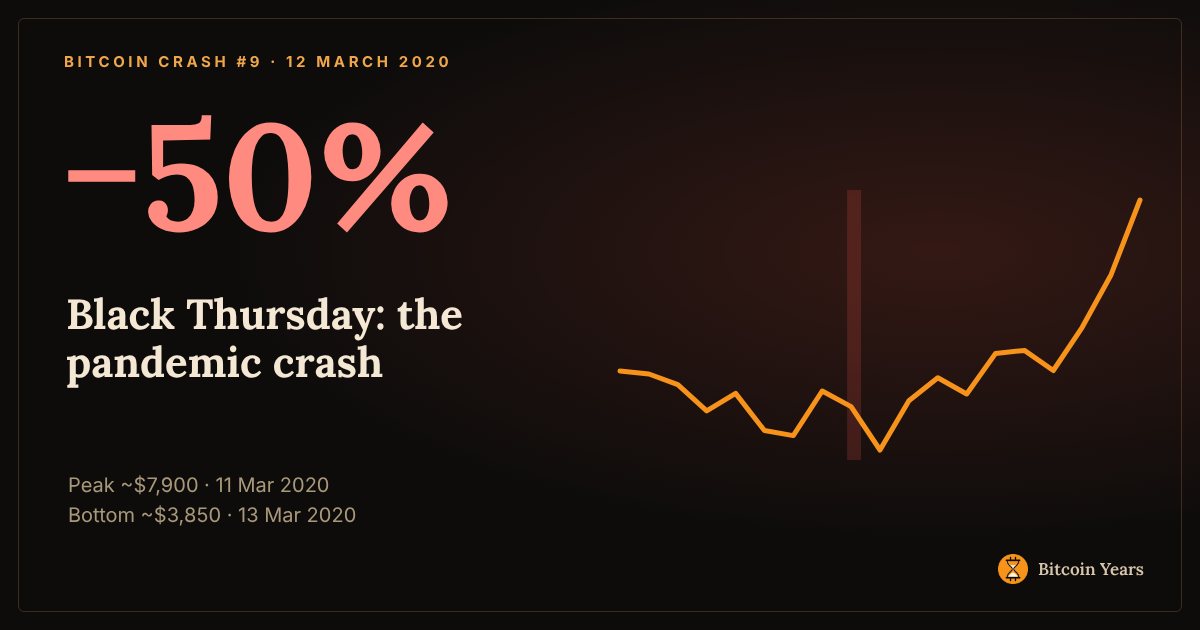
In early 2020 Bitcoin was recovering, back above $10,000 in February, with a halving expected in May. Then COVID-19 spread around the world. On 11 March the World Health Organization declared a pandemic, and on 12 March every market on earth seemed to sell at once.
Bitcoin lost almost 40% that day, one of the worst single days in its history. Leveraged traders were wiped out in waves; more than a billion dollars of long positions were liquidated, and on the BitMEX exchange the price briefly fell below $4,000 before the platform went offline. From the evening before, it was a fall of about half.
The recovery was just as dramatic. Central banks and governments unleashed trillions of dollars of support, and the case for a fixed-supply asset suddenly sounded urgent to new investors. Bitcoin was back above its pre-crash level within weeks, halved its reward in May and ended 2020 near $29,000.
The lesson: In a true panic, everything gets sold. What matters is what people buy afterwards.
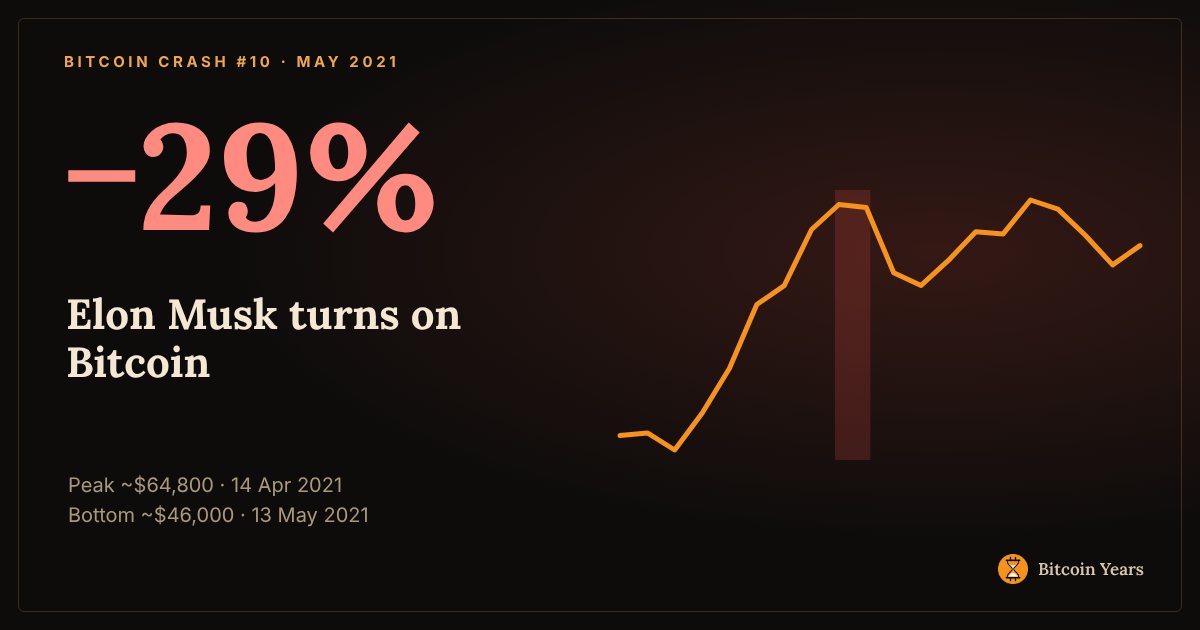
Spring 2021 was euphoric. Tesla had announced a $1.5 billion purchase of bitcoin and said it would accept it as payment for cars. Coinbase listed on the Nasdaq, and on 14 April Bitcoin reached about $64,800, a new record.
On 12 May, a single post reversed the mood. Elon Musk said Tesla would stop accepting bitcoin, citing the fossil fuels burned by mining. The man who had done more than anyone to bring Bitcoin into the mainstream that year was now its most famous critic. Within a day the price fell to around $46,000.
The episode started a fierce debate about Bitcoin’s energy use that pushed miners toward renewable power and transparency reports. Tesla kept most of its coins for another year. Bitcoin passed its April record in October, without needing Tesla’s approval.
The lesson: A celebrity can move the price for a day. The network does not need anyone’s endorsement.
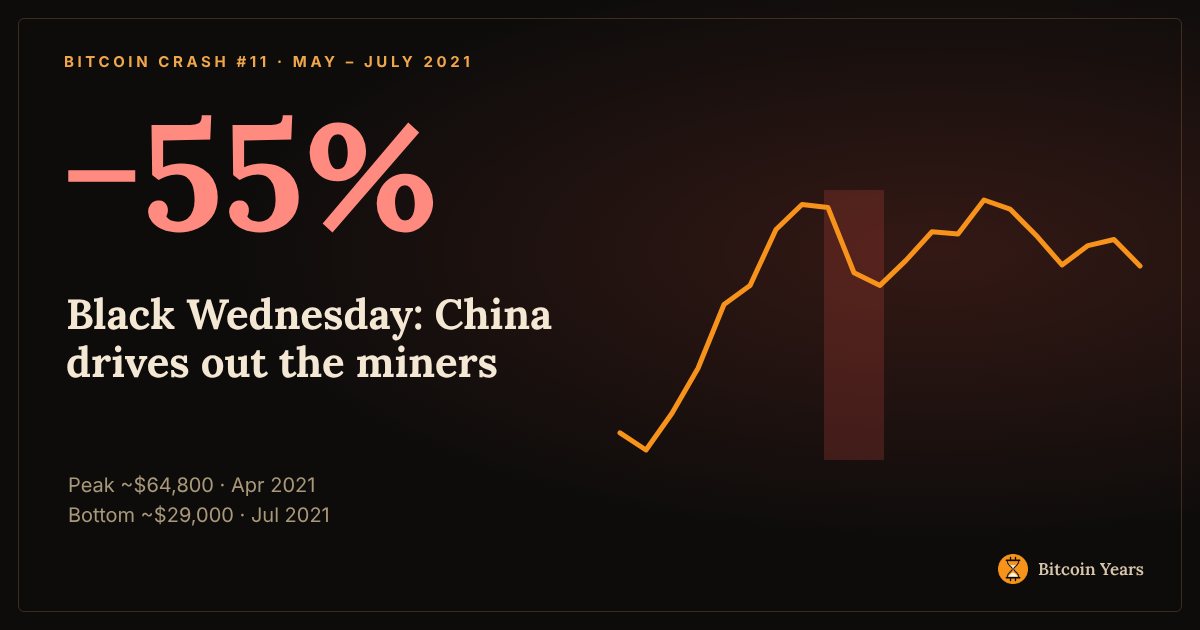
A week after Tesla’s reversal, China reiterated its ban on crypto transactions and signalled a crackdown on mining. On 19 May, remembered as Black Wednesday, Bitcoin fell about 30% within hours, briefly touching $30,000, and billions of dollars of leveraged positions were liquidated.
Then came the hammer. Over the following weeks Chinese provinces ordered mining farms to shut down, and the country that had hosted most of the world’s mining switched it off almost overnight. About half of the network’s computing power went dark, and in July Bitcoin touched about $29,000, some 55% below its April record.
The network barely blinked. Blocks slowed for a while, the difficulty adjusted down, and miners shipped their machines to the United States, Kazakhstan and elsewhere. In October Bitcoin set a new record. The world’s biggest mining country had left, and Bitcoin had become more decentralised, not less.
The lesson: Half the miners can disappear and the network keeps going. That is what decentralisation means in practice.
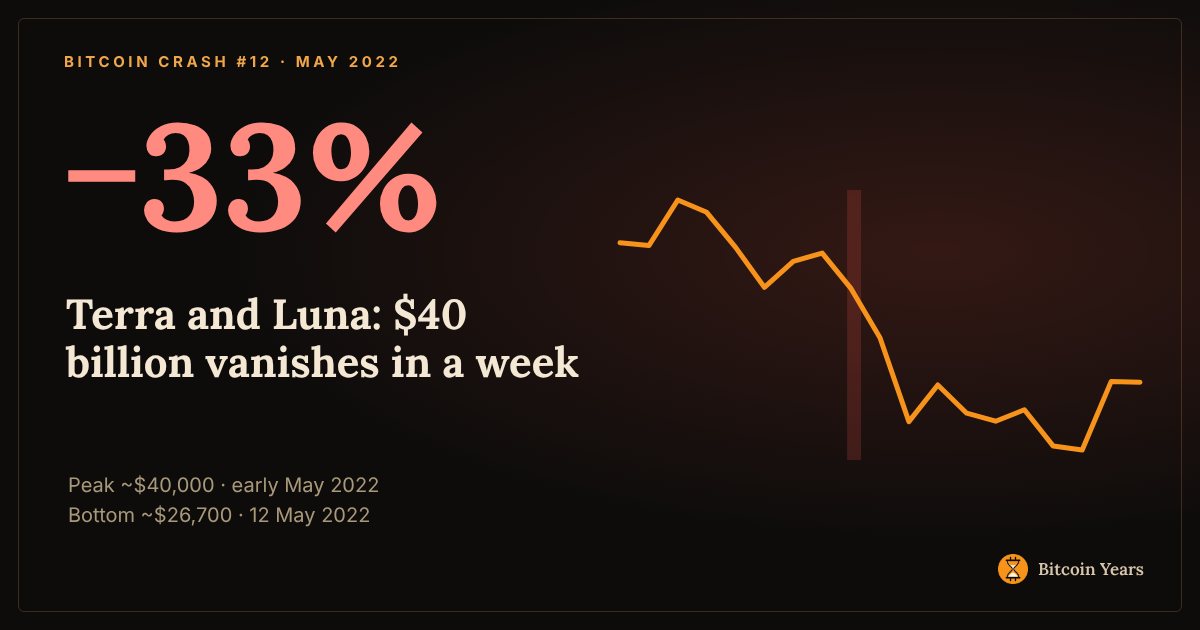
Bitcoin had peaked at about $69,000 in November 2021, just as the Federal Reserve prepared to raise interest rates fast. By spring 2022 it was already well down, but the real damage came from a project that promised something impossible: a stablecoin backed by nothing but an algorithm.
TerraUSD was supposed to hold a value of one dollar, kept in balance by its sister token, Luna, and lured savers with a 20% yield. On 9 May it slipped below its peg and never recovered. Within days Luna fell to almost nothing and about $40 billion of value disappeared. The project’s backers had bought tens of thousands of bitcoin as a reserve, and sold them in a failed rescue.
Bitcoin fell from about $40,000 to around $26,700 by 12 May. Millions of people, many of them in Asia, lost their savings. Terra’s founder was later convicted of fraud. It was the first domino in a year that would bring down much of the industry around Bitcoin.
The lesson: A 20% “stable” yield is not stable. Someone always pays for it.
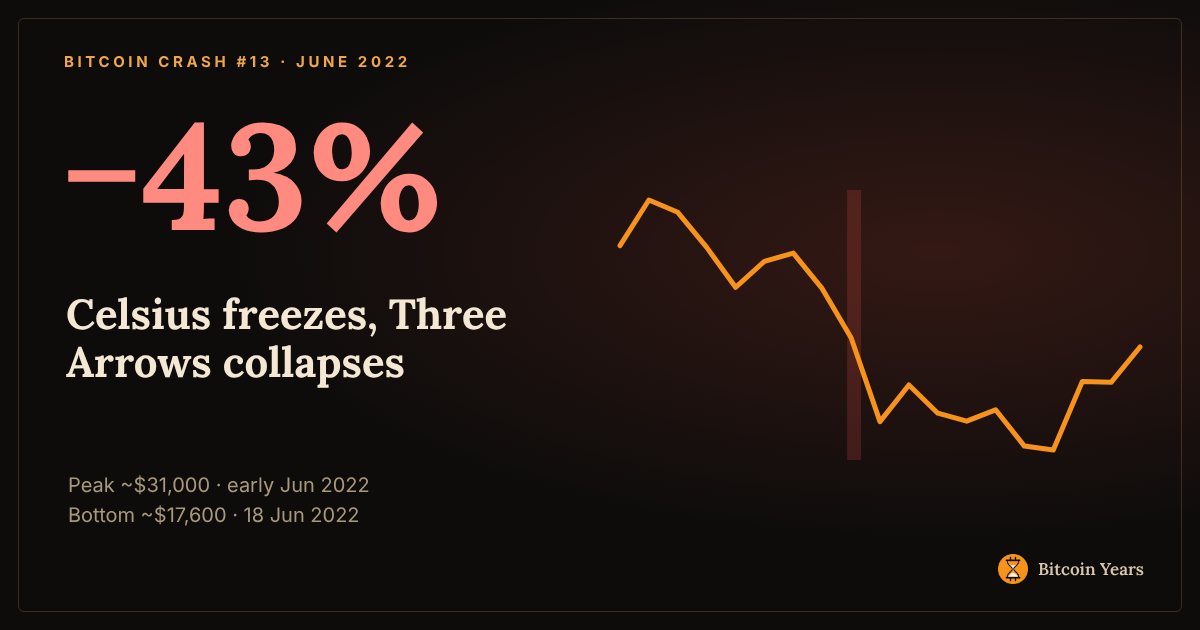
The Terra collapse exposed who had been lending to whom. On 12 June the crypto lender Celsius, which had taken deposits from more than a million customers with promises of high interest, froze all withdrawals, citing extreme market conditions.
Days later it emerged that Three Arrows Capital, one of the biggest crypto hedge funds, could not meet its loans after heavy losses on Luna. Lenders that had trusted it, from Voyager to BlockFi, were dragged down with it. Celsius, Voyager and Three Arrows all ended in bankruptcy that summer.
Bitcoin broke below its 2017 high of about $20,000 for the first time and touched about $17,600 on 18 June. Celsius customers waited years to get part of their money back, and its founder was later sentenced to prison. The lesson was brutal: lending your coins for yield turns them into a loan to someone you cannot see.
The lesson: Yield on bitcoin means lending it to someone. If they fail, so does your “savings account”.
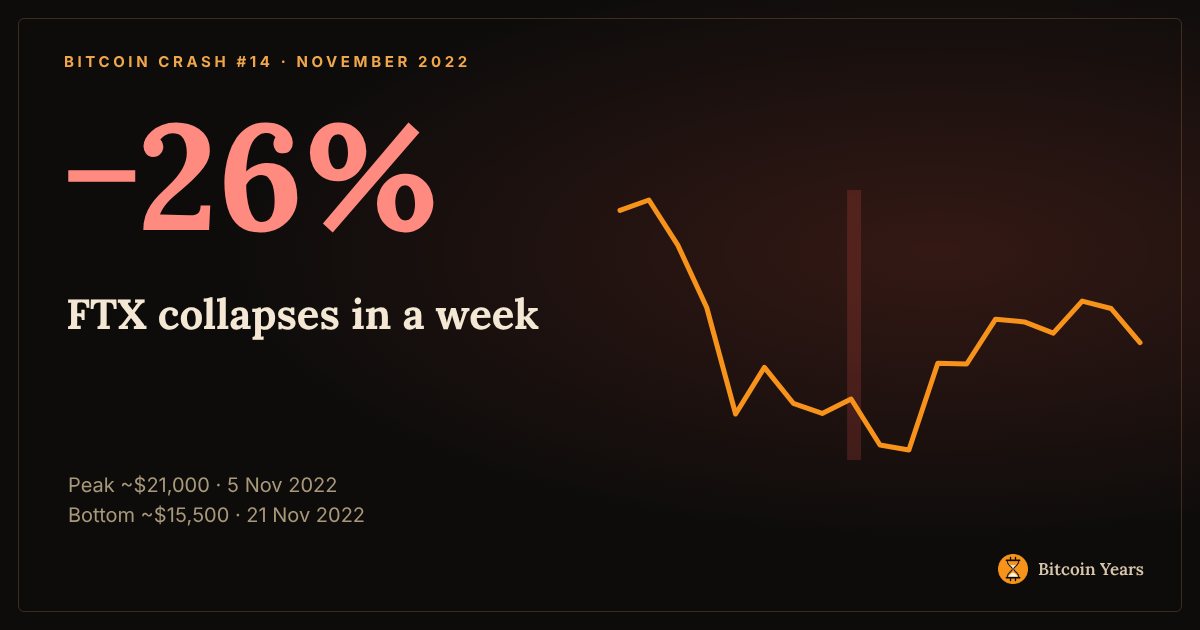
By autumn 2022 FTX looked like the winner of the crisis. It was the world’s second-largest exchange, its founder was on magazine covers and in Washington, and it had stepped in to rescue failing rivals.
On 2 November a report revealed that much of the balance sheet of Alameda Research, FTX’s sister trading firm, was made of FTX’s own token. Days later Binance said it would sell its holdings, and customers rushed to withdraw. On 8 November FTX stopped processing withdrawals. On 11 November it filed for bankruptcy, with a hole of billions of dollars of customer money. Its founder was later convicted of fraud and sentenced to 25 years in prison.
Bitcoin fell from about $21,000 to around $15,500, its lowest point of the cycle and 77% below the 2021 record. It was the end of a year in which almost every company that had promised safety on top of Bitcoin failed, while the Bitcoin network itself kept producing a block every ten minutes.
The lesson: Leverage and promises of safety broke, not Bitcoin. Not your keys, not your coins.
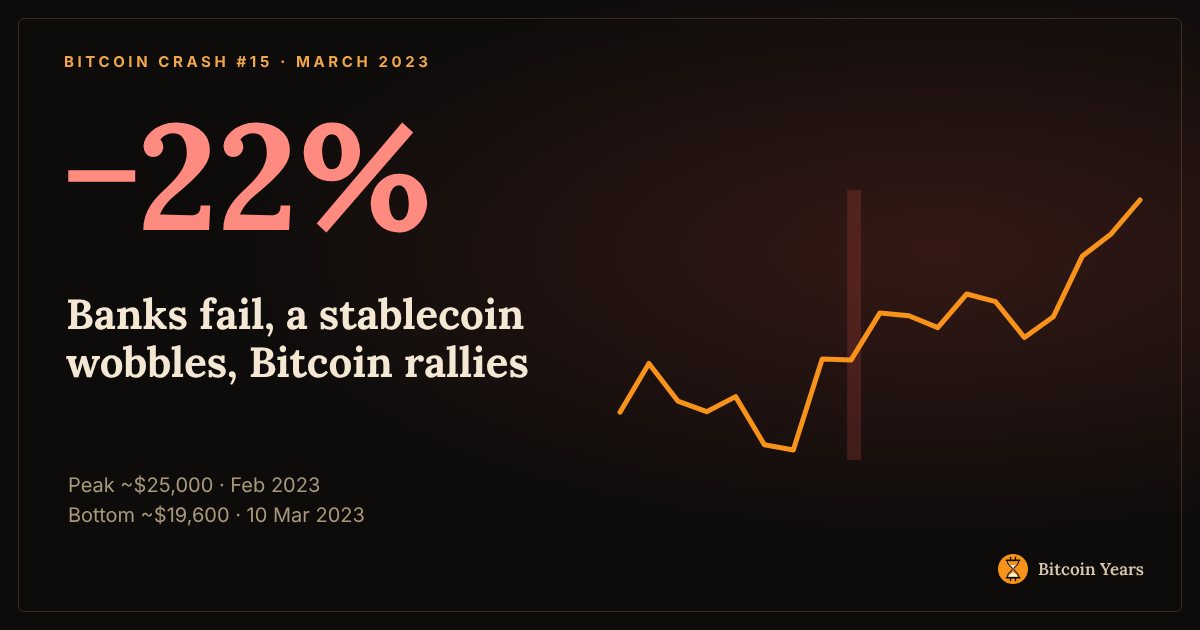
In March 2023 the crisis came from the traditional banking system. Silvergate, a bank used by many crypto firms, announced it would wind down, and on 10 March Silicon Valley Bank collapsed in the second-largest bank failure in US history. Bitcoin slipped below $20,000.
The next day it emerged that Circle, the issuer of the USDC stablecoin, had $3.3 billion of reserves stuck at SVB. USDC, supposed to be worth exactly one dollar, briefly fell to about 87 cents. For a weekend it looked as though a banking crisis might become a crypto crisis.
Instead, it became a reminder of why Bitcoin exists. When US authorities guaranteed SVB’s deposits, the panic eased, and Bitcoin rose above $28,000 within ten days. The crash that wasn’t became the start of the next rally.
The lesson: Bitcoin was born in a banking crisis. Sometimes it rises in one.
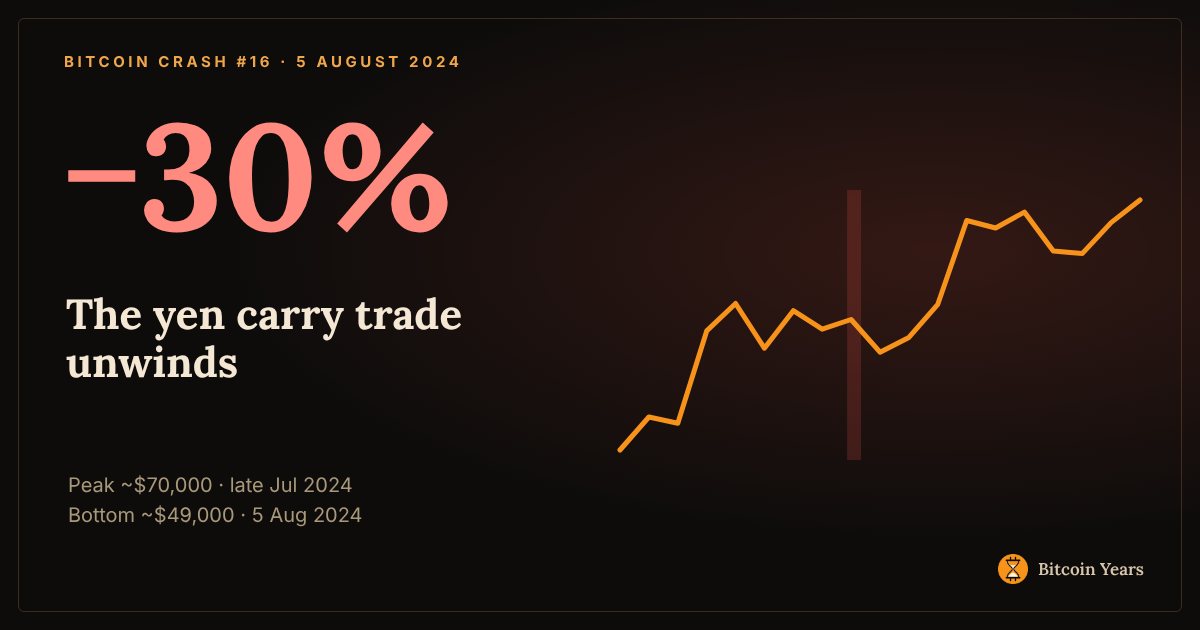
For years, investors had borrowed cheaply in Japanese yen and invested the money elsewhere, from US tech stocks to crypto. On 31 July 2024 the Bank of Japan raised interest rates. The yen jumped, and the borrowed money had to be paid back fast.
On Monday 5 August the unwind hit everything. Japan’s Nikkei index had its worst day since 1987, and Bitcoin, which had been near $70,000 a week earlier, crashed about 18% in a day to roughly $50,000, briefly trading around $49,000. Crypto markets saw heavy liquidations as leveraged positions were forced closed.
Calm returned within days once the Bank of Japan signalled it would not rush further hikes. Three months later Bitcoin was making new records after the US election. The episode showed how tightly Bitcoin had become tied to global money flows.
The lesson: Bitcoin now trades in the same pond as every other asset. When the tide goes out, it feels it.
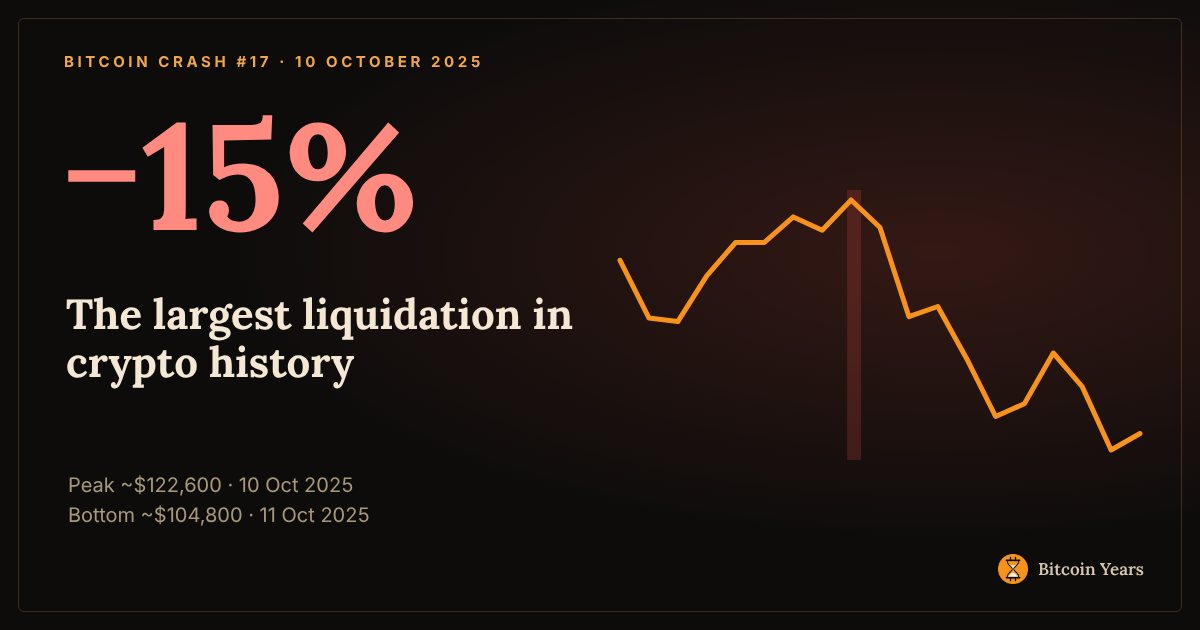
Bitcoin had just set an all-time high of about $126,000 on 6 October 2025, and leverage in the market was at record levels. On the afternoon of Friday 10 October, US time, President Trump announced a 100% tariff on Chinese imports.
Hours later, as US markets closed for the weekend, the selling turned into a cascade. Over $19 billion of leveraged positions were forcibly closed and more than 1.6 million traders were liquidated, the largest event of its kind on record. About $3.2 billion was wiped out in a single minute. On Binance, the stablecoin USDe briefly traded at 65 cents, and some altcoins lost a third of their value in minutes.
Bitcoin fell about 15% from its Friday high to around $104,800. It was not the deepest fall in percentage terms, but it broke the market’s confidence. In hindsight, 10 October marked the turning point from the record of 2025 to the bear market of 2026.
The lesson: Leverage turns a bad headline into a crash. Bitcoin held without borrowing cannot be liquidated.
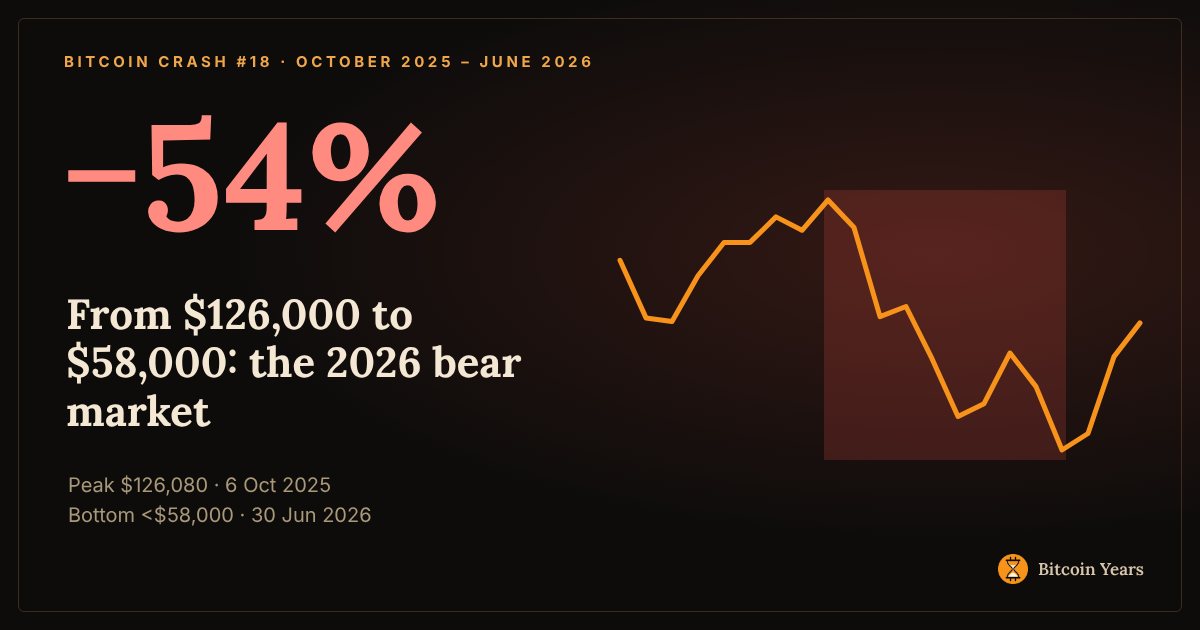
After the October shock, Bitcoin never regained its footing. It slipped below $90,000 by December, rallied to about $98,000 in January 2026, and then fell hard. Geopolitical tension, a broad sell-off in tech stocks and the nomination of Kevin Warsh to lead the Federal Reserve weighed on risk assets, while investors pulled billions of dollars out of spot bitcoin ETFs.
On 5 February 2026 Bitcoin fell 17% in a day, briefly touching about $60,250, more than half below its record only four months earlier. Futures traders shed tens of billions of dollars of leverage, and miners who had borrowed to move into AI data centres sold coins to support their balance sheets.
The pressure returned in early summer. Strategy, the company that had become Bitcoin’s most famous buyer, disclosed its first-ever sale of bitcoin, ETF outflows continued and a wallet linked to Mt. Gox moved about $950 million of coins. On 30 June Bitcoin slid below $58,000, about 54% under its peak. By October it had recovered to the low $80,000s. Whether that was the bottom is a question only the next chapter can answer.
The lesson: Every cycle so far has included a fall of more than 50%. Every one so far has eventually been followed by a new high.
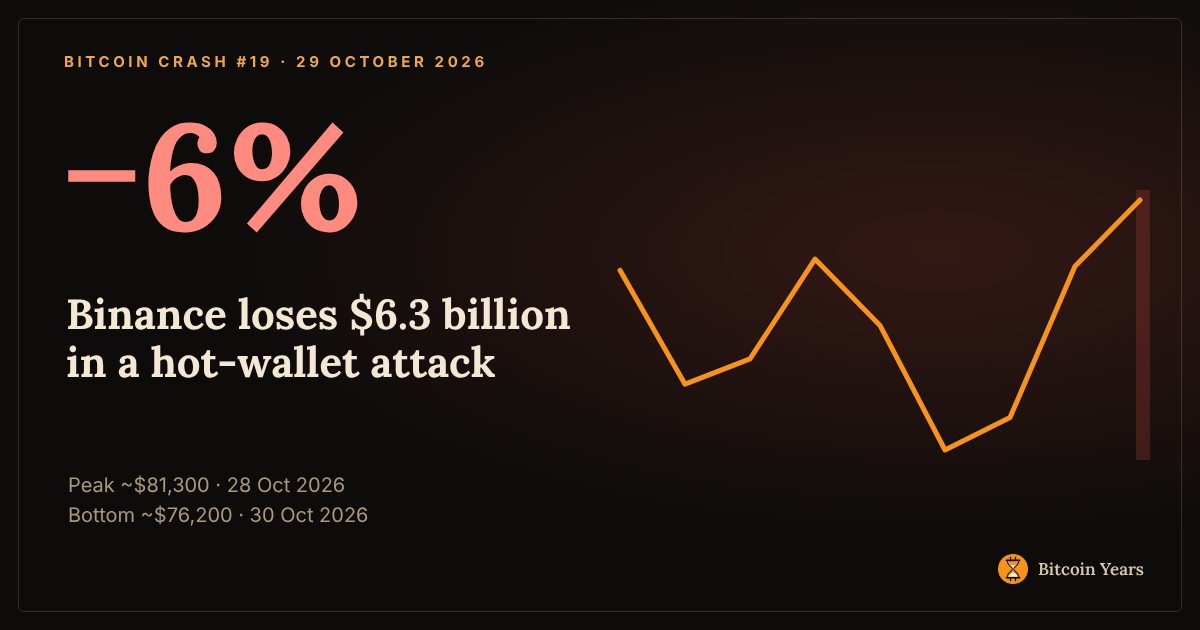
The most recent shock came from the exchange that had dominated the market since 2018. On the afternoon of 29 October 2026, attackers drained Binance hot wallets across about ten blockchains in roughly 20 minutes, taking about $6.3 billion, including around 18,270 bitcoin. US authorities and blockchain analysts attributed the attack to North Korean hackers.
Binance halted withdrawals and said its users would not bear the loss, and stablecoin issuers froze about $3 billion of the stolen funds within hours. Bitcoin fell about 4% that day and touched about $76,200 the next, as spot ETFs recorded $643 million of outflows. October 2026 closed 7.3% lower, the weakest October since 2014.
It was a smaller fall than Mt. Gox had caused twelve years earlier, and Binance said within two days that it had replaced 90% of the losses. But the lesson was the same one Bitcoin has been teaching since 2011.
The lesson: Fifteen years, the same lesson: the safest bitcoin is the one you control yourself.
Look at the list again and a pattern appears. Almost none of these crashes was caused by Bitcoin itself. The protocol was broken once, in 2010, and fixed in hours. Everything else was the world around it: exchanges that lost coins, lenders that promised safe returns, frauds, bans, borrowed money and global panic.
The four long bear markets, in 2011, 2014, 2018 and 2022, each followed a bubble, wiped out between 77% and 93% of the price and took between about a year and a half and three years to recover. The sudden crashes, like Black Thursday or 10 October 2025, were usually fuelled by leverage and were over within days, even if the damage to confidence lasted longer.
None of this predicts what happens next. But it explains why long-time holders talk about Bitcoin in years rather than days, and why the oldest advice in the community is still the best: do not borrow to buy it, do not leave it with someone else, and never invest more than you can afford to lose.
Frequently asked questions
What was the biggest Bitcoin crash?
In percentage terms, the 2011 crash after the first Mt. Gox hack, when the price fell about 93% from roughly $32 to about $2. The deepest falls since then were 2013–2015 (about 85%), 2017–2018 (about 84%) and 2021–2022 (about 77%).
How long does Bitcoin take to recover from a crash?
It has varied from days to about three years. After the deepest bear markets of 2014 and 2018, it took roughly three years to pass the previous high. After the 2021–2022 crash it took about two years and four months.
Has Bitcoin always recovered after a crash?
Every crash before 2025 was eventually followed by a new all-time high. Past performance does not guarantee the future, and the 2025–2026 decline had not been recovered as of October 2026.
What usually causes Bitcoin crashes?
Most major crashes were triggered by failures around Bitcoin rather than in it: exchange hacks and bankruptcies (Mt. Gox, Bitfinex, FTX, Binance), fraud, government bans, leverage unwinding and global market panics.
Figures are rounded and compiled from public sources listed under each story. Nothing here is financial advice.
 Bitcoin Years