Monthly report · October 2026 Bitcoin in October 2026: A red “Uptober” and the Binance hack
Bitcoin Years · Published 2 November 2026
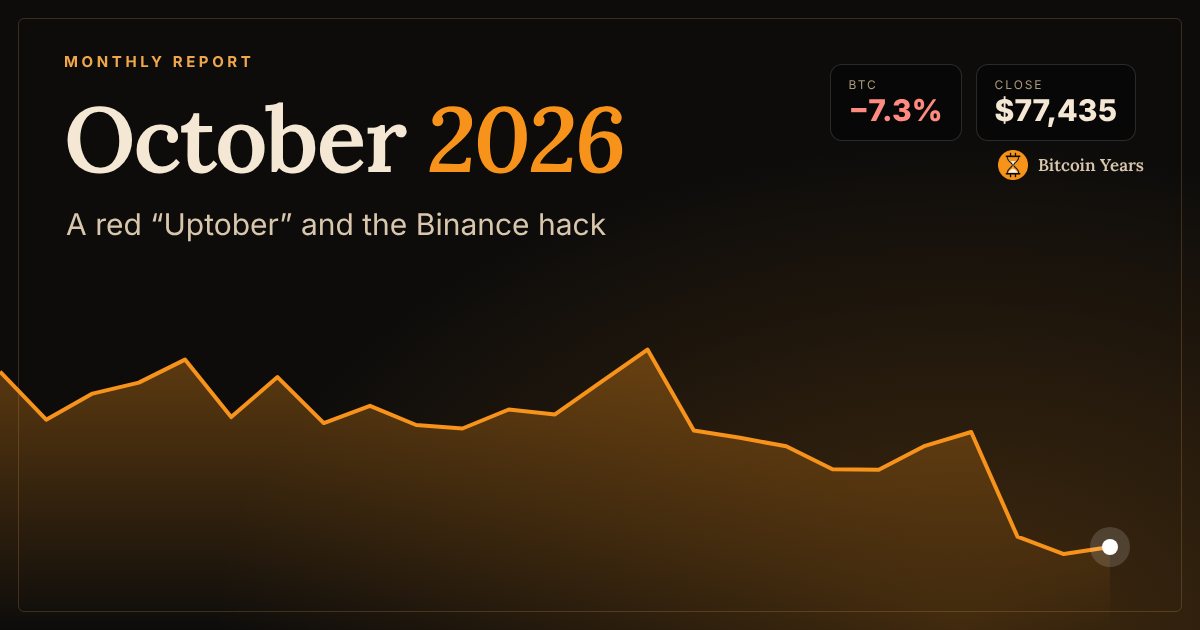
Bitcoin closed October 7.3% lower, its weakest October since 2014. Early optimism faded into steady selling, and the month ended with one of the largest exchange hacks on record.
Open$83,554
Close$77,435
Change−7.3%
High$87,146
Low$76,190
Daily closing price, 7–31 October 2026 (US dollars). The month’s intraday high of about $87,100 came in the first week.
Market
“Uptober” turns red: Bitcoin posts its weakest October since 2014
Bitcoin entered October near $83,500 and briefly pushed above $87,000 in the first week. The move did not hold. Through the middle of the month the price drifted in a narrow band between roughly $81,000 and $84,000 as buyers grew cautious.
The decisive move came at the end. After the Binance hack on 29 October the price fell below $78,000, touched about $76,200 on 30 October and closed the month at about $77,435. That is a 7.3% loss for the month.
October has a strong record for Bitcoin: 11 of the 16 Octobers from 2010 to 2025 ended higher, which is why traders call it “Uptober”. This one was the fourth-worst October on record, and the first time since 2011–2012 that two Octobers in a row ended lower (October 2025 fell 3.9%).
Why it matters: Seasonal patterns are not a strategy. October 2026 was driven by flows and by an exchange security failure, not by the calendar.
On the afternoon of 29 October, attackers drained Binance hot wallets across about ten blockchains in a coordinated attack that began on the XRP Ledger and moved to Ethereum and Bitcoin within minutes. Roughly $6.3 billion was taken, including about 18,270 BTC (around $1.5 billion) and about $3.8 billion in Ethereum-based assets.
Binance first said a software engineer’s compromised laptop was used to authorise the withdrawals. Chief executive Richard Teng later said the attackers had abused EIP-7702, an Ethereum account feature, to take control of the hot wallet. Blockchain analysts at TRM Labs and an FBI alert attributed the attack to TraderTraitor, a North Korean group linked to Lazarus.
Binance halted withdrawals the same day. Tether and Circle froze linked wallets within minutes, and about $3 billion of stolen stablecoins was frozen in total. Binance said users would not bear the loss. On 31 October it said it had replenished 90% of the stolen funds from its own reserves, including its Secure Asset Fund for Users (SAFU). Withdrawals began reopening on 1 November.
Market impact: Bitcoin fell about 4.3% on the day, and leveraged liquidations across crypto exceeded $1.5 billion within 24 hours. The hack revived an old Bitcoin lesson: coins held on an exchange are only as safe as the exchange.
Sources: Wikipedia (2026 Binance hack, citing Binance, TRM Labs and the FBI); Bitquery; Bitcoin.com News. The investigation is ongoing and details may change.
Institutional flows
Spot bitcoin ETFs post $515 million of net outflows
US spot bitcoin ETFs ended October with about $515 million of net outflows, after 13 days of inflows and 9 of outflows. The best day was 21 October (+$528 million). The worst was 30 October (−$643 million), the day after the Binance hack.
The total hides a sharp split. BlackRock’s IBIT took in about $932 million over the month, while Fidelity’s FBTC lost about $755 million and ARK’s ARKB about $444 million.
Net flows by fund, October 2026 (US$ millions). Source: TFTC.
Why it matters: ETFs are now the main channel for institutional demand. The outflows show money rotating towards the largest fund and pulling back after bad news, not a broad exit.
Source: TFTC Bitcoin ETF tracker.
Macro
The Fed holds rates, and two officials vote for a hike
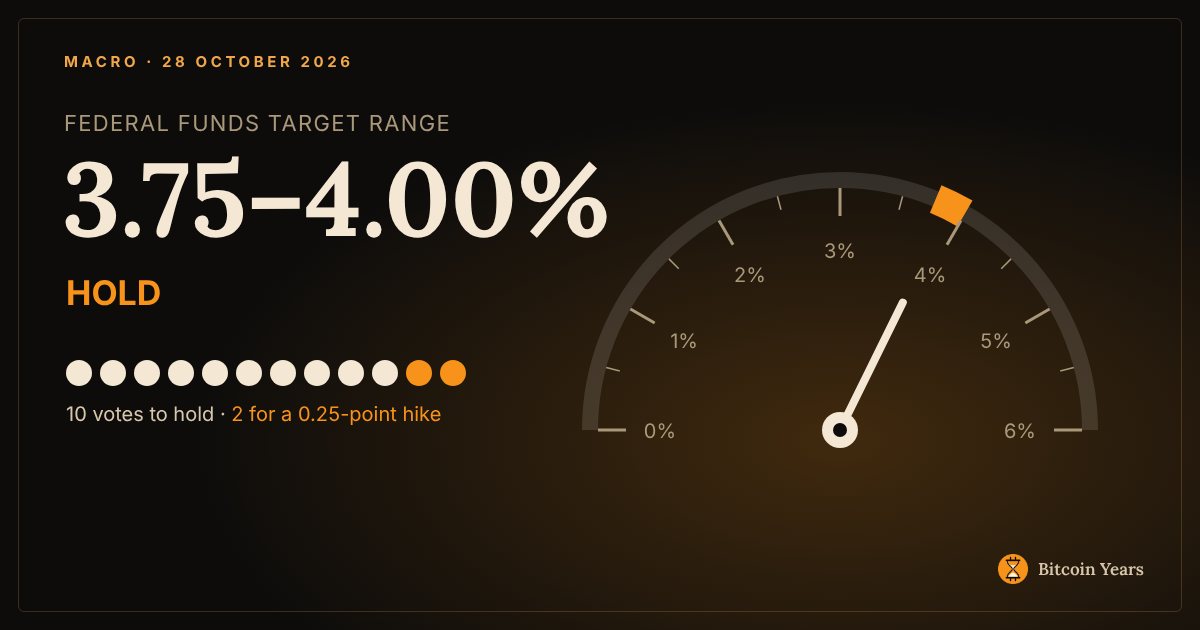
On 28 October the Federal Reserve kept its target range at 3.75–4.00%, where it had stood since a hike on 16 September. The vote was 10–2: Lisa Cook and Beth Hammack both preferred another 25-basis-point increase. The statement said economic activity was expanding at a strong pace and that inflation remained elevated.
Why it matters for Bitcoin: Higher rates make safe returns more attractive and tend to weigh on risk assets. A hawkish hold with dissents in favour of a hike pushed back hopes of cheaper money.
Source: Verified Investing, citing the Federal Reserve statement of 28 October 2026.
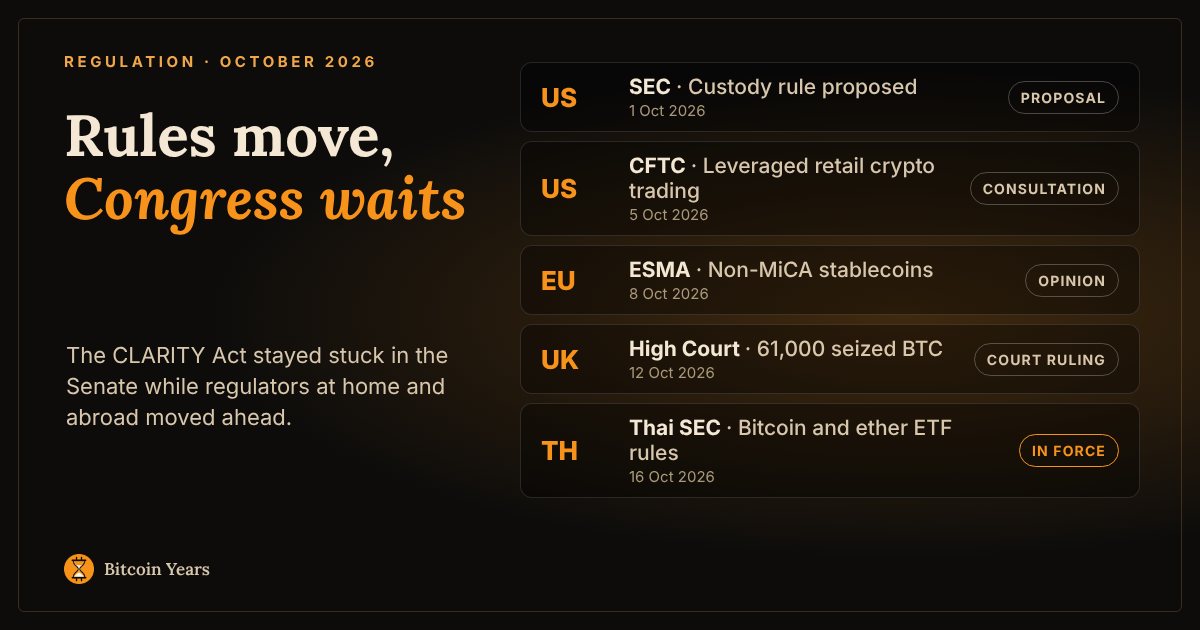
The CLARITY Act, the main US market-structure bill, stayed stuck after a failed Senate cloture vote in September (49–50), and the Senate was out of session from early October. Regulators kept moving instead. The SEC proposed custody rules for advisers and funds holding crypto (1 October), and the CFTC opened a consultation on leveraged retail crypto trading (5 October).
Abroad, Europe’s ESMA told MiCA-licensed firms to stop serving non-compliant stablecoins (8 October), the UK High Court ruled on the law that applies to about 61,000 seized bitcoin (12 October), and Thailand’s rules for bitcoin and ether ETFs took effect (16 October). Most of these are proposals or first steps, not final law.
Source: Bullrunners regulation roundup, October 2026.
Network
Bitcoin Core 32.1 ships, and miners keep turning to AI
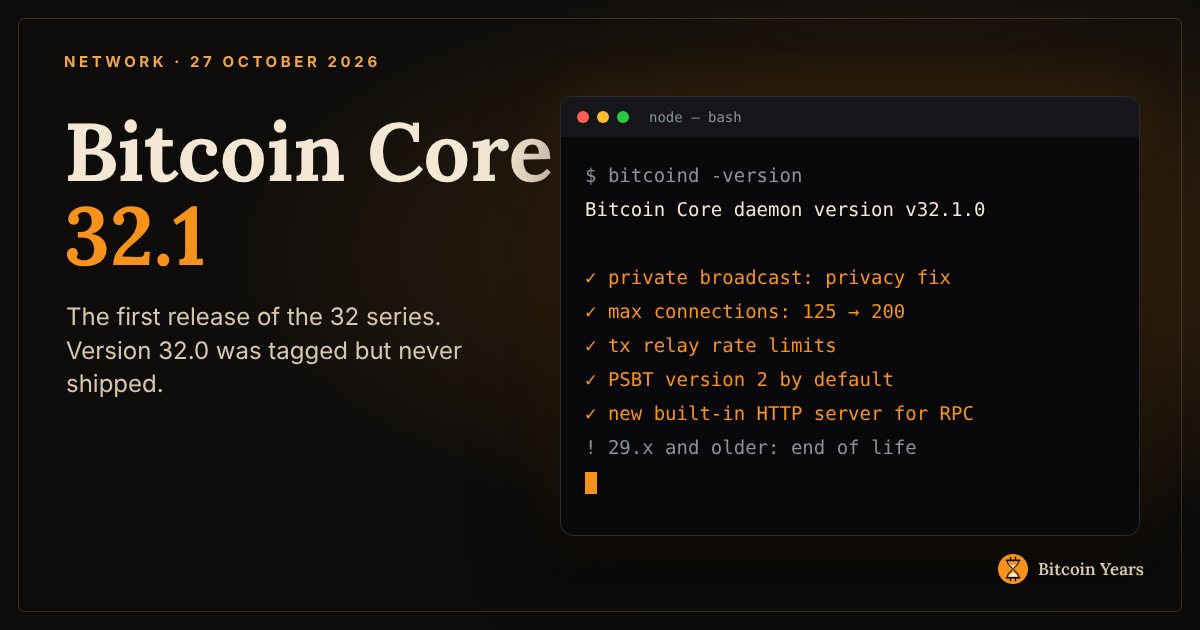
Bitcoin Core 32.1 was released on 27 October. Version 32.0 had been tagged but never fully released because of last-minute issues, so 32.1 is the first release of the 32 series. Changes include a privacy fix for the new private transaction broadcast feature, rate limits on outgoing transaction relay, a higher default number of peer connections (from 125 to 200), a new built-in HTTP server for the RPC interface and version 2 PSBTs by default. Versions 29.x and older are now end of life.
On the mining side, difficulty was flat at the 3 October adjustment and hashrate held near 945 EH/s, about 18% below its October 2025 peak. Several public miners continued to move capacity to AI data-centre clients.
Why it matters: Software upgrades rarely move the price, but they are how Bitcoin keeps improving without a company in charge.
Sources: Bitcoin Core release notes; MillionMiner (a mining-hardware seller).
Chronology
October 2026, day by day
The SEC proposes rules on how investment advisers and funds can hold crypto assets in custody. Comments are due 7 December.
Bitcoin trades up to about $87,100, the high of the month.
Mining difficulty barely moves (−0.03%) as hashrate holds near 945 EH/s.
The CFTC opens an advance notice of proposed rulemaking on leveraged retail crypto trading.
Europe’s ESMA tells MiCA-licensed firms to stop serving stablecoins that do not comply with MiCA.
The UK High Court rules that Chinese law governs fraud victims’ claims to about 61,000 seized bitcoin. An appeal is reportedly planned.
Thailand’s rules for bitcoin and ether ETFs take effect.
Bitcoin posts its highest close of the month, about $84,000. US spot ETFs take in $528 million, their best day of October.
Bitcoin Core 32.1 is released.
The Federal Reserve holds rates at 3.75–4.00% in a 10–2 vote. Both dissenters wanted a hike.
Binance loses about $6.3 billion in a hot-wallet attack. Bitcoin closes down about 4.3% at roughly $77,800.
US spot bitcoin ETFs see $643 million of net outflows. Bitcoin touches the month’s low near $76,200.
Binance says it has replenished 90% of the stolen funds. Bitcoin closes the month at about $77,400.
Binance begins reopening withdrawals.
What October meant
October 2026 showed how much of Bitcoin’s short-term path now depends on institutions and infrastructure rather than on the calendar. ETF money rotated and pulled back, the Fed refused to ease, and the biggest exchange in the market suffered a multi-billion-dollar breach.
At the same time, the network itself was untouched: blocks kept coming, the software kept improving, and the stolen funds were mostly frozen or replaced. Heading into November, the questions are whether ETF inflows return, how fast trust in Binance recovers, and when the Fed will be ready to cut.
Figures are rounded and compiled from public sources; prices vary slightly between exchanges. This report covers the main developments of the month, not every story. Nothing here is financial advice.